

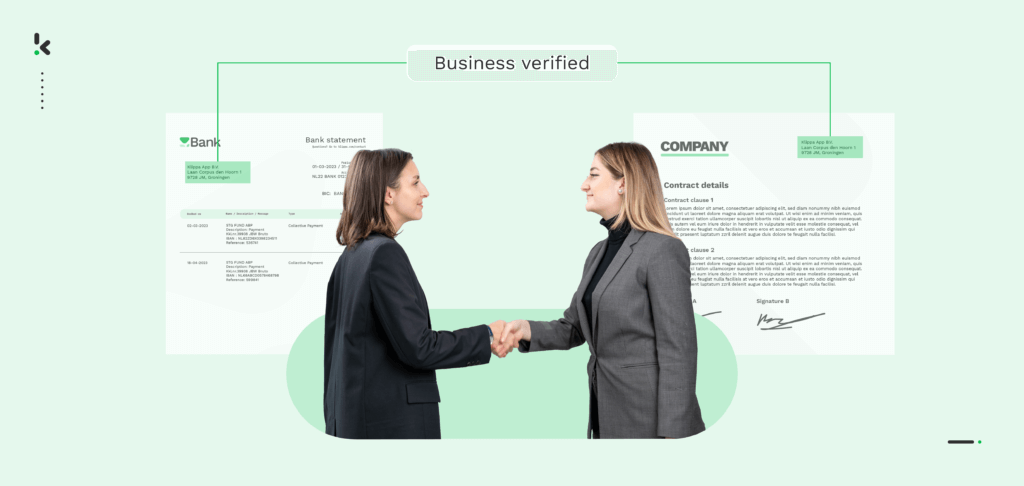
Financial crimes are a constant threat to businesses everywhere. Imagine finding out that a trusted business partner has been involved in financial fraud. Such a discovery can put your reputation and stability at risk. It’s only natural to want to protect your business against such risks. And that’s precisely where Know Your Business (KYB) comes into play.
KYB is more than just another compliance check; it’s a process to ensure the integrity of your partners therefore protecting yourself. In this blog, we will explain what KYB entails and why it is essential for your business’s safety and growth.
Key Takeaways
- KYB is a mandatory due diligence process that protects businesses from fraud, money laundering, terrorism financing, and hidden ownership risks.
- Manual KYB document processing slows onboarding, increases the risk of errors, and makes compliance harder to scale.
- Automated KYB processing uses AI and OCR to extract, validate, and store partner data quickly and accurately.
- Automation strengthens fraud detection by identifying forged, altered, or incomplete documents in real time.
- Integrating KYB automation into business systems streamlines operations and supports growth into new markets.
What is Know Your Business (KYB)?
KYB is a due diligence process made for businesses to verify the identity and legitimacy of the entities they work with. It involves checking the legal status, ownership structure, and financial health of companies before forming any business relationships
What is the difference between KYC and KYB?
KYC and KYB are both important verification processes that aim for the same goal: to safeguard businesses from fraud by following Anti Money-Laundering (AML) regulations. However, they differ in terms of their targets.
KYC is focused on individuals, examining their personal information and financial behavior while KYB is concerned with corporate entities.
What are the Legal Requirements of KYB?
Know Your Business (KYB) requires several key elements. During this process, you need to ensure that the business complies with local and international laws, including Financial Crimes Enforcement Network (FinCen), the Financial Action Task Force (FATF), and the EU’s Anti-Money Laundering directive.
Financial Crimes Enforcement Network: FinCEN is a part of the American Treasury that fights financial crimes such as money laundering and terrorist financing. It does so by gathering and analyzing transaction data for law enforcement and national security purposes.
Financial Action Task Force: FATF is an international organization that also sets global measures to combat Money-Laundering (ML) and funding terrorism. It evaluates countries’ compliance with regulations and improves worldwide standards.
EU’s Anti-Money Laundering (AML) directive: The EU’s AML framework consists of directives and regulations made to increase transparency in financial transactions, improve due diligence for financial institutions, and foster cooperation among member states to prevent and detect money laundering within the EU.
As you’ve noticed, KYB is absolutely vital worldwide! Now, let’s see if this holds true across different industries as well.
Which Organizations Should Perform KYB?
To meet security regulations, institutions across diverse industries must adopt KYB practices.
- Financial Institutions: Banks, credit unions, and financial entities handle large money transfers, facing high risks of money laundering and fraud. KYB verifies if companies’ services are legit, ensuring AML compliance.
- Law Firms: Involved in sensitive transactions, law firms must verify client legitimacy. Through KYB, they authenticate corporate clients, shielding against the creation of false company profiles which could damage their reputation and result in legal complications.
- Real Estate Companies: Real estate deals involve substantial budgets, attracting those involved in money laundering. Hence, real estate companies must confirm property ownership and entity legitimacy. For instance, by doing so, they can avoid individuals using shell companies to purchase properties with illegal funds.
- E-commerce Platforms: Hosting numerous sellers, e-commerce platforms like marketplaces are vulnerable to fraudulent activities such as vendors selling counterfeit goods. Seller identities are confirmed with KYB, protecting against legal troubles and building consumer trust.
- Any Business Engaging in Transactions with Other Businesses: Regardless of industry, B2B companies risk dealing with unreliable parties. Partners, vendors, and clients’ identities are verified to reduce financial risks and boost security.
In a nutshell, making KYB a part of your process is a smart move if your business relies on regular collaborations with other companies. The good news is that the benefits of KYB extend far beyond that!
What Are the Benefits of KYB?
Know Your Business provides multiple layers of protection for your business. But there’s more! Let’s explore the additional benefits that KYB can offer you.
- Enhanced Regulatory Compliance: KYB ensures businesses meet legal standards, avoiding fines and penalties associated with non-compliance.
- Improved Business Relationships: KYB fosters trust and transparency, leading to more secure and reliable partnerships.
- Streamlined Business Operations: With a clear understanding of the businesses you’re dealing with, KYB can help streamline decision-making and operational processes.
- Competitive Advantage: Companies that implement KYB are seen as more trustworthy, attracting more clients and partners.
- Global Market Access: KYB compliance opens doors to international markets that have strict regulatory requirements, expanding business opportunities.
- Protection Against Reputational Damage: Avoiding associations with fraudulent or non-compliant businesses protects your brand’s integrity.
- Financial Stability: By mitigating the risks of fraud and ensuring compliance, KYB contributes to the overall financial stability of your business.
You see? Numerous benefits to it! In the next section, we’ll explore what the KYB actually entails.
What Does Know Your Business Look Like?
KYB involves a few steps that are crucial to comply with the regulations. Identity verification, background checks, and document verification are the three non-negotiable parts you will need to take into account.
Identity Verification for KYB
Identity verification checks during KYB aim to identify and verify not only the business you’ll be working with but also its shareholders.
Business Identification and Verification
This involves collecting basic information about the business, including its legal name, address, and registration number, and verifying this information against official records.
To verify such details, various types of documents can be requested. You can consider business registration documents, such as certificates of incorporation, chamber of commerce documents, or any other legal documents that establish the business entity.
Additionally, you can request documents that prove the business’s address, such as utility bills, lease agreements, or property ownership documents.
Ultimate Beneficial Owner Check (UBO)
An ultimate beneficial owner check is the process of identifying individuals who have significant control or ownership of a business. Generally, these individuals are defined as having ownership of more than 25% of the company’s shares or voting rights.
To conduct this check, you will need documents such as shareholder lists, partnership agreements, or organizational charts that detail the ownership structure of the business.
Financial Health and Background Checks
During KYB, you need to assess a business’s financial stability by analyzing financial statements, bank statements, and credit reports.
Additionally, you must conduct background checks on a business that provides insights into its operational history, legal disputes, and financial integrity. It involves reviewing public records, legal databases, and news sources for any red flags such as previous involvement in money laundering, fraud, or other criminal activities. You may also check sanctions lists, politically exposed persons (PEP) lists, and adverse media.
Document Verification
Document verification in KYB not only requires making sure of the authenticity of the document provided but also regular review and updates of information. It’s essential to capture any changes in ownership, legal status, or financial health that could affect risk assessment.
This thorough investigation provides a comprehensive understanding of who you’re doing business with, enabling informed decision-making. These can seem like a lot of processes. However, by using intelligent document processing software, it is just a lot easier to go through.
Manual KYB Processing vs Automated KYB Processing
While KYB checks safeguard your business, the method you use to process KYB documents directly impacts speed, accuracy, and compliance reliability.
Manual KYB Document Processing
Even with a clear KYB framework, traditional verification relies heavily on human effort:
- Documents arrive via email or post and must be manually sorted and checked.
- Data from certificates, shareholder records, and proof‑of‑address files is typed into internal systems by hand.
- Cross‑checking with official registries can require separate log‑ins or formal requests, often in different jurisdictions and languages.
- Reviews vary depending on the individual conducting them, leading to inconsistent compliance outcomes.
Automated KYB Document Processing
Automation streamlines this into one standard, repeatable workflow:
- Documents are uploaded via secure portals or APIs.
- Key details (company name, registration number, address, shareholder data) are extracted instantly using Optical Character Recognition (OCR) and AI.
- The data is auto‑matched against official databases and sanctions/PEP lists in real time.
- Fraud detection algorithms flag manipulated or incomplete files before approval.
Manual KYB document processing is slow and prone to inconsistencies, while automated processing enables faster, more accurate, and fully scalable verification. This shift in method is essential for businesses that need to maintain compliance and trust at scale.
Benefits of Automated KYB Document Processing
Automating KYB document verification delivers faster partner onboarding, reduces compliance risks, and provides consistent, audit‑ready results that manual methods struggle to achieve. By replacing human‑dependent steps with AI‑driven validation and fraud detection, businesses gain both operational efficiency and stronger regulatory alignment.
Stronger Compliance Accuracy
Automation applies AML, counter‑terrorist financing (CFT), and other regulatory rules in exactly the same way for every submission. This removes the risk of human interpretation errors and creates a repeatable process that meets global standards such as FATF and EU AML directives.
Significant Time Savings
KYB verification that might take days with manual processing can be completed in minutes. Faster onboarding means quicker contract execution and the ability to respond rapidly to new opportunities.
Better Fraud Prevention
Automated systems can run authenticity checks to detect forged business licenses, altered shareholder records, or falsified proof of address documents. These checks work in real time, reducing the chance of approving a high‑risk or fraudulent partner.
Lower Operational Costs
Reducing the number of staff hours spent on data entry and manual cross‑checking lowers compliance department costs. Resources can be redirected toward complex, high‑risk cases that require human judgment.
Scalable Global Coverage
Automated KYB platforms can process documents in multiple languages and verify them against diverse national registries, making it easier to expand into new regions without additional staffing.
Enhanced Audit Trails
Each step in the verification process is logged digitally, producing clear records that can be presented during regulatory audits or internal reviews. This supports transparency and builds trust with stakeholders.
How to Automate Your KYB Document Processing
Automating KYB verification is achieved by combining intelligent document processing tools with secure integrations to compliance databases and business systems. A well‑designed setup replaces repetitive manual tasks with fast, accurate, and compliant digital workflows. Following is a step-by-step guide on how to automate your KYB document processing.
1. Centralize Document Intake
Provide partners with a secure upload portal or API endpoint where they can submit required KYB documents in formats such as PDF, image files, or scanned copies.
2. Apply OCR and Data Extraction
Use AI‑powered optical character recognition to identify and capture key details from each document including company name, registration number, address, shareholder information, and dates.
3. Automate Validation
Connect extracted data to official registries, sanctions lists, and politically exposed persons (PEP) databases for instant verification. This ensures partners are legitimate and compliant with AML and CFT rules.
4. Detect Fraud in Documents
Run authenticity checks to identify altered files, missing pages, mismatched metadata, or signs of digital manipulation. Flag suspicious documents for manual review.
5. Classify and Store Documents
Automatically categorize files by type such as “Business Registration,” “Proof of Address,” or “UBO Declaration,” and store them securely in compliance‑approved formats.
6. Integrate with Business Systems
Send verified data directly to your existing CRM, ERP, or compliance platform. This reduces duplicate entry and ensures decision‑makers have accurate information.
7. Monitor for Ongoing Compliance
Set alerts for changes in partner registration, ownership, or sanctions status. This supports continuous KYB vigilance beyond initial onboarding.
Automating KYB document processing is not just about speed. It creates a consistent, tamper‑resistant compliance framework that can handle high volumes while meeting strict regulatory requirements, making it an essential step for businesses that engage with multiple partners.
Automate Your KYB Processes with Doxis
Doxis AI.dp automates the KYB process, offering a seamless, efficient, and secure way to conduct due diligence. Our platform simplifies identity verification and document checks, enabling you to focus on growing your business while maintaining high compliance and security standards.
By integrating Doxis’ solutions, you benefit from a streamlined KYB process that not only meets but exceeds regulatory expectations, ensuring your business is fortified against the threats posed by unreliable businesses.
During your KYB process, Doxis’ solution can automatically:
- Automatically extract information from financial documents or legal documents within a few seconds to avoid manual data entry errors.
- Verify the authenticity of these documents with document fraud detection to ensure regulatory compliance.
- Anonymize sensitive data from documents to protect the privacy of your business partners.
- Classify documents per type to make the process more efficient.
- Send information to your preferred destination which can be cloud-based drives, CRM or ERP software, and more to easily find the information ensuring fast decision-making.
Ready to elevate your business’s security and compliance? Contact us today to learn more about how Doxis’ KYB solutions can benefit your business.
FAQ
KYB is a regulatory due diligence process that verifies the legitimacy, legal registration, ownership, and operational status of a business partner. It prevents financial crimes including money laundering, terrorism financing, fraud, and the use of shell companies.
2. How does KYB differ from KYC?
KYC verifies the identity of individuals, while KYB verifies corporate entities. Both aim to meet Anti‑Money Laundering (AML) and Counter‑Terrorist Financing (CFT) requirements but KYB focuses on company documents, ownership structures, and operational legitimacy.
3. What are Ultimate Beneficial Owners (UBOs) and why check them?
UBOs are the real people who ultimately own or control a company, usually holding 25 percent or more of shares or voting rights. Screening UBOs in KYB ensures they are not sanctioned, politically exposed, or linked to criminal activities.
4. What documents are required for KYB verification?
Common KYB documents include:
– Business registration certificates
– Proof of business address such as utility bills or lease agreements
– Shareholder lists or partnership agreements
– Financial statements and credit reports
– Sanctions and PEP screening reports
5. What is the difference between manual and automated KYB document processing?
Manual processing involves staff reviewing and typing data from submitted documents into compliance systems, which is slow and prone to errors. Automated KYB uses OCR and AI to extract, verify, and validate document data in real time, improving accuracy and speed.
6. What are the benefits of automating KYB document processing?
Automation improves compliance accuracy, detects fraud instantly, reduces labor costs, verifies partners faster, scales across multiple jurisdictions, and provides complete audit trails for regulators.
7. How can a business automate its KYB process?
Automation can be achieved by setting up a secure document intake portal, extracting data with OCR, validating details against official registries and sanctions lists, detecting document fraud, categorizing files, integrating verified data into CRM or ERP systems, and setting alerts for any future changes.
8. How does Doxis AI.dp support KYB automation?
Doxis AI.dp automates KYB by extracting data from business documents in seconds, validating details with sanctions and PEP screenings, detecting fraud, anonymizing sensitive data, and routing verified information directly into your compliance or business systems.