



Hiring the wrong person is not just a bad fit. It can lead to heavy government fines, compliance breaches, and reputational damage. Under strict regulations such as the UK Home Office guidelines, employers are legally required to confirm every candidate’s eligibility to work before they start their role.
As of 2025, strict right to work compliance checks apply in regions such as the UK, United States, and Netherlands, each with unique document and verification procedures.
Traditionally, this process meant manually inspecting passports, visas, and work permits. This was a time-consuming, error-prone task that left HR teams struggling to balance speed with accuracy. In 2026, AI-powered Right to Work (RTW) checks are transforming how businesses hire.
Through secure digital platforms known as Identity Service Providers (IDSPs), candidates can upload identification, verify documents, and take a live selfie to confirm their identity in minutes. Employers receive instant compliance reports, fraud detection alerts, and full audit trails to satisfy government requirements and internal governance policies.
Key Takeaways
- Automation saves time by replacing manual ID checks with instant digital verification.
- AI-powered fraud detection prevents identity theft and document tampering that human eyes might miss.
- Compliance is guaranteed through integration with official government systems like the UK Home Office Digital Verification Service.
- Audit-ready records help HR teams meet GDPR and Home Office requirements while reducing risk.
- Doxis AI.dp supports multiple document types, languages, and fraud detection techniques for seamless global hiring.
Proving the right to work – What does that mean?
Employers must confirm every applicant’s legal right to work before hiring. In countries like the UK, US, and Netherlands, this is a legal requirement that protects businesses from fines and ensures compliance with national employment laws.
An applicant’s “right to work” is proven by presenting valid identity and eligibility documents during the hiring process. The type and number of documents required depend on factors such as nationality, visa status, and country of origin.
The visual below shows some examples of documents that count as proof of the right to work.
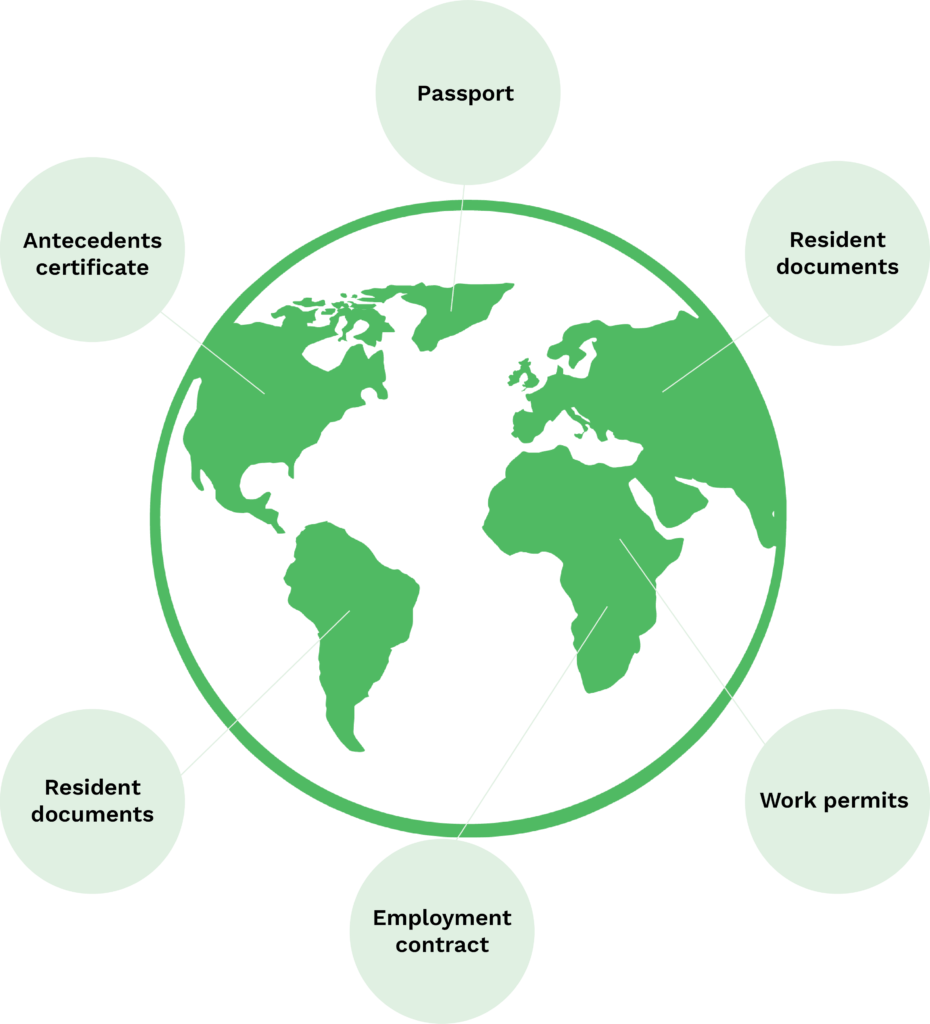
Checking these documents ensures that:
- The applicant is legally allowed to work in the country.
- The company meets compliance obligations under local employment and immigration laws.
- Fraudulent or falsified information is detected before onboarding.
In short, right to work checks protect your organisation from fines, strengthen hiring integrity, and ensure compliance with government regulations.
Why do companies check the right to work?
With globalization and the increase of workers from all around the world, all businesses must conduct a right to work check as part of the employment screening process. The reasons why it is so vital for companies to do so are:
- Protect a business from potential legal implications like fines or imprisonment if uncovered that employees are not eligible to work
- Ensure integrity and honesty of applicants and employees → Being upfront about visa and working entitlements shows honesty and integrity of candidates and employees
- Legal obligation → If the right to work is not checked before employment, companies can be fined large sums
Let’s have a look at three example countries to illustrate which documents are needed to perform a right to work check and therefore protect a company from legal implications.
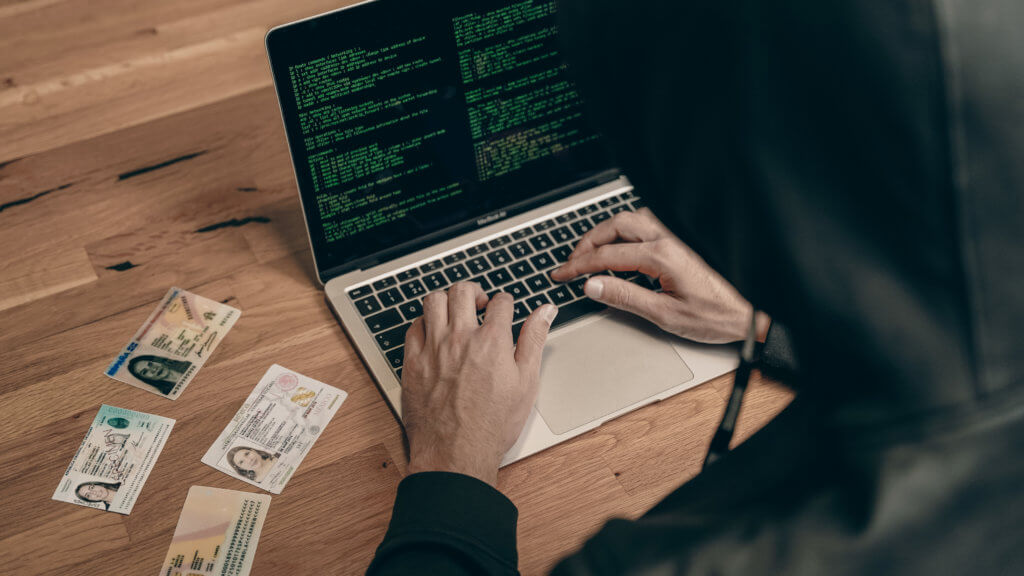
Which documents are needed?
Numerous documents prove the right to work of an applicant. Which documents are needed largely differs from country to country. In the following, we cover three countries and discuss which documents are needed:
- The Netherlands
- The United States
- The United Kingdom
Note: In order to ensure readability of this blog, we decided to cover only three countries. To cover the specific requirements of each country wouldn’t be feasible. Please check for yourself which regulations and documents apply to your specific country.
Netherlands Right to Work Check Requirements
If an applicant wants to work in the Netherlands, there are several documents that need to be collected in order to prove the right to work.
A Dutch citizen receives a Citizen Service Number (BSN) when born and registered at the local municipality. Every other person who is moving to the Netherlands gets this number when registering at the city hall. The BSN serves a number of purposes, including drawing up an employment contract.
In addition, if an applicant wants to work in the Netherlands, the right residence documents or work permits need to be provided. This counts especially for people who come from outside the EU and Switzerland.
Furthermore, a valid passport or other form of identification, and an antecedents certificate need to be provided. On top of that (if an applicant is from outside the EU), an employment contract with an employer that is a registered sponsor by the Dutch Immigration & Naturalisation Services (IND) is required to prove the right to work.
United States Proof of Eligibility to Work
In general, in order to prove the right to work in the US, an applicant must provide an unexpired US passport or a permanent residence card. If that can’t be provided, the applicant needs to be able to show an unexpired foreign passport that contains a temporary I-551 stamp.
In addition, the US has so-called “right to work states” that have implemented the right to work law. Keep in mind though, that in the US, the term right to work (law) refers to the financial contribution to labor unions and protects workers from an obligatory union membership. It doesn’t refer to the actual right to work.
UK Right to Work Check Process
Obviously, when seeking employment in the UK, also here a passport or other form of identification is required. Important to mention is, that if the holder of the passport is not British or a national of an EEA country or Switzerland, the passport needs to fulfill certain requirements.
The passport must be endorsed and show that the holder is allowed to stay in the UK or is currently allowed to work. On top of that and depending on the situation of the applicant, other documents that must be provided may include:
- Permanent resident card
- National identity card
- Registration certificate
- Biometric immigration document
- Immigration status document
- Birth or adoption certificate
- Certificate or registration of naturalization
- Residence card
The UK government offers additional information on this matter, which helps to clarify the requirements.
As we already briefly mentioned differences in the meaning of the term right to work, we would like to have a closer look at the US and the UK and identify where these differences come from.
Right to work – Difference between US and UK
The right to work law, which is in force today in the US, dates back to 1947. This law is mainly in place so that employees get the benefits of union contracts without paying fees to a union.
Furthermore, it protects workers from employers who want to force their employees to join a union. With the right to work law in place, employers can’t make union membership a requirement for employment anymore. This allows employees to have the freedom to choose a membership voluntarily instead.
As you can see, the right to work law in the US has very little to do with the actual right to work.
This is a significant difference to the right to work check in the UK. The United Kingdom has a rule in place, that everybody, British or international, has to literally prove the right to work before employment. Therefore, pre-employment screenings have to be conducted.
In recent years, in the face of the Covid-19 pandemic and the increasing number of international workers in the UK, this pre-employment procedure faced significant challenges. This forced the UK government to implement a system that checks the right to work of every individual online.
Let’s have a closer look at how the right to work check can be completed in the UK.
How is the right to work check completed in the UK?
In order to complete the right to work document check, there are two different ways that can be followed:
- Manual right to work check
- Digital/online right to work check
Manual right to work check
The manual document check refers to a physical face to face meeting in which a physical copy of the right to work document is obtained. It is the employer’s responsibility to check and identify fraudulent documents during the meeting.
If all documents are in order, the employer needs to copy every single document, making sure that all necessary information is clearly visible on the copy. These copies must be retained for the duration of the employment contract, plus a further two years after the employee leaves the company.
Digital/online right to work check
Accelerated by the Covid-19 pandemic, the UK government has made changes to the guidance on right to work checks. These changes enable employers to conduct pre-employment checks digitally.
In order to conduct the hiring process, the person seeking employment has to request a 9-character long “share code” from the UK “Home Office”. In the same portal, the employer can then enter this code along with the individual’s date of birth, obtaining access to the individual’s details in the migrant section.
An online meeting is scheduled, in which the employer needs to download the required documents. Those need to be checked and verified. Again, it is the employer’s responsibility to check for fraudulent documents.
Unfortunately, online right to work checks led to a number of identity and document fraud cases. Often, it is incredibly difficult to detect fraudulent documents with the bare eye. That’s why more and more companies are deciding to use technology to automate fraud detection.
Let’s dive into the technology that can automate right to work checks.
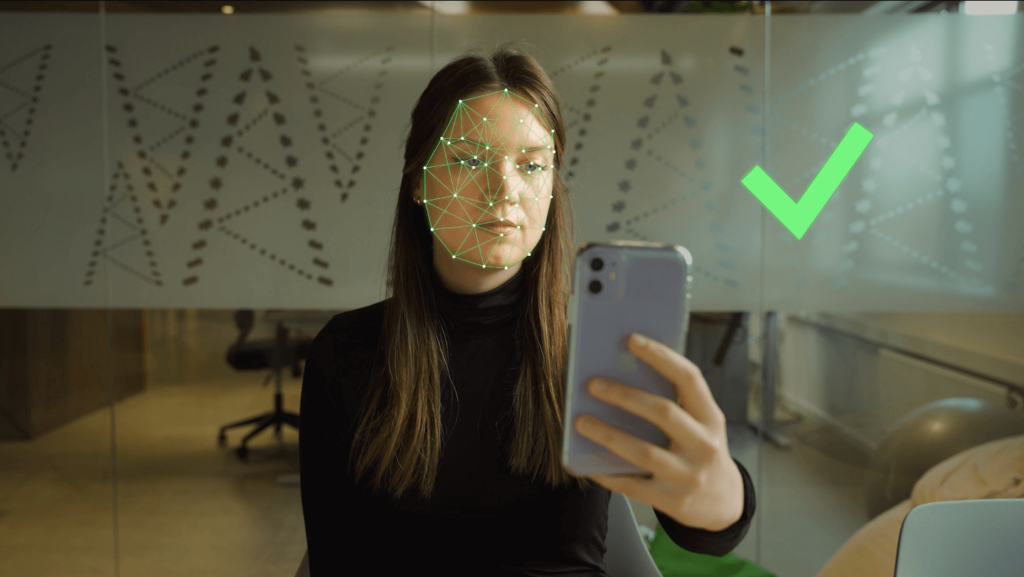
Technology that automates right to work checks
With the help of technology, right to work checks can be automated. The process becomes reliable, fast, and accurate. Furthermore, fraudulent documents can automatically be detected, making right to work checks a saver process.
Let’s have a closer look at automated data extraction and automated fraud detection.
Automated data extraction
Onboarding new employees always leads to a high volume of documents. While manual data extraction of ID documents, contracts and visas is error-prone and time-consuming, IDP can automate the extraction of data.
That way, time is saved, errors are kept to a minimum and costs cut. This is especially important when onboarding new people, as you want to ensure that only correct data is saved. The IDP software is able to recognize the type of document automatically, and then reliably extracts, converts and verifies the required information within a couple of seconds.
On top of that, fraud and duplicates can be detected. Let’s have a closer look at that next.
Automated fraud detection
With an Intelligent Document Processing (IDP) solution, right to work checks can be strengthened. With the help of Artificial Intelligence (AI) and Machine Learning, IDP solutions can become more sophisticated in fraud detection over time.
This is also highly necessary, as fraudsters are increasingly getting better at manipulating documents and information. Scammers make use of graphics processing and deep fake engineering, which makes detecting fraudulent documents with a human eye impossible.
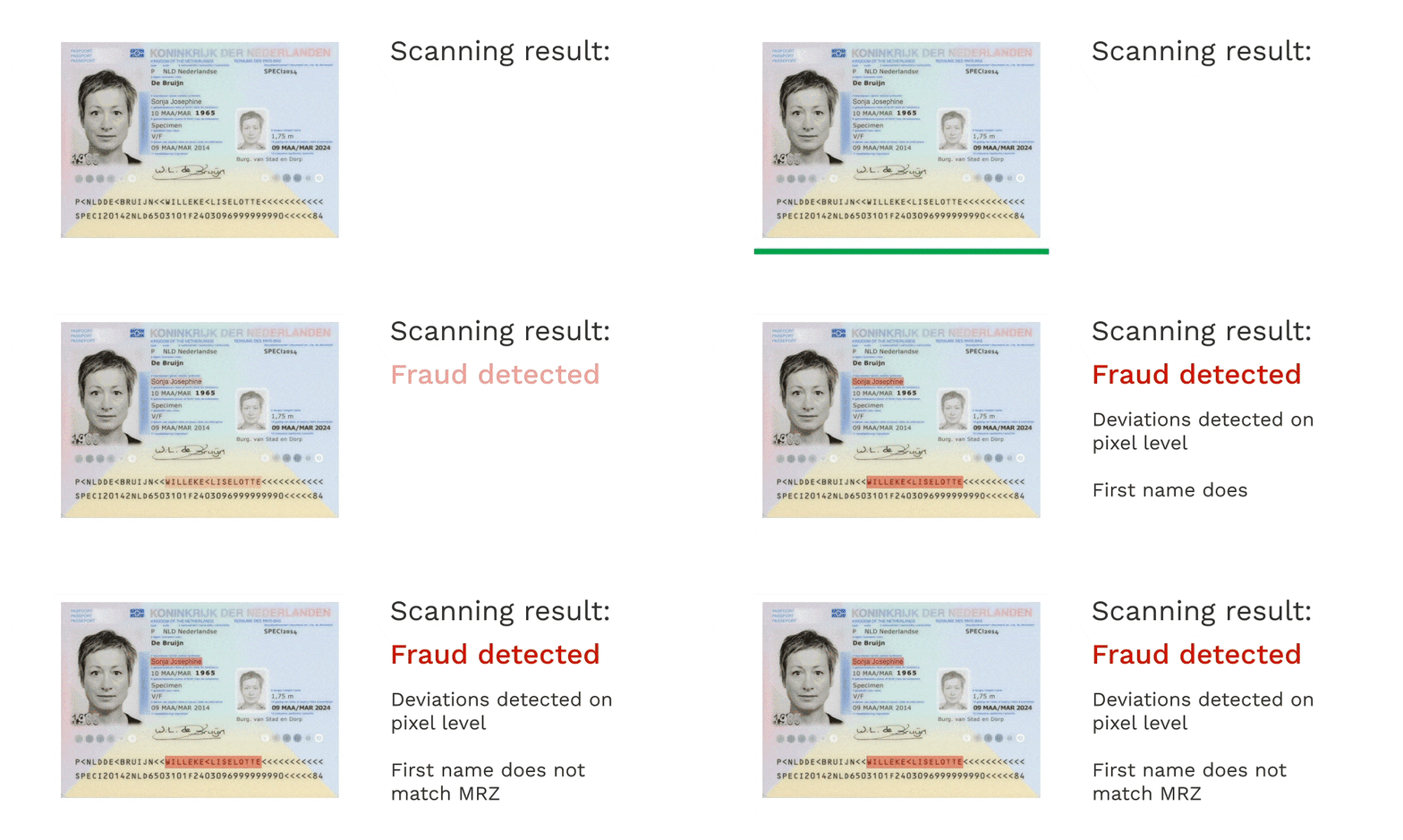
IDP providers use an automated procedure that scans different elements and data fields in a document. During that procedure and with the help of Photoshop detection and EXIF analysis, fraud can be detected reliably.
Manipulating a document with Photoshop is sadly quite easy. Removing or adding text that manipulates the status of the right to work can have terrible consequences for the employer. While a human would not be able to detect the manipulation, the software can quickly discover the fraudulent document with Photoshop detection.
On top of that, an EXIF analysis can be carried out by the IDP software. Like in the example picture below, the metadata of a document is read out. You can see that in the software field, Adobe Photoshop is mentioned, which is a clear indication that the document is manipulated.
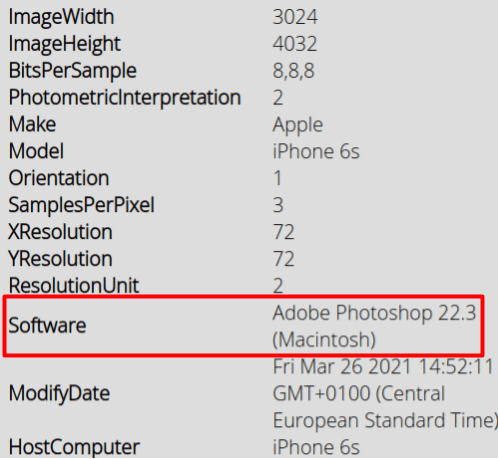
All of these automated checks can be carried out in seconds. While you are getting to know an applicant in the recruitment meeting, the software reliably checks and verifies the provided documents. You can then make an informed decision about whether to employ the person or not.
Why choose Doxis to help with your right to work checks?
Doxis can help you to perform a smooth right to work check. Whether you simply want to extract, identify and verify information from CVs, ID cards, government documents or work permits, Doxis AI.dp provides the right service.
On top of that, our solution provides EXIF analysis, Handwriting analysis and Copy-Move Forgery Detection to help you detect identity and document fraud. Furthermore, Doxis supports several languages on documents, making it easy for you to hire international employees.
Are you interested in seeing how our technology can help you automate right to work checks in action? Plan a demo using the form below, and let us show you! In case you have some questions, you can of course always contact one of our experts.
Frequently Asked Questions
Skipping a right to work check can lead to heavy fines, legal issues, and reputational damage. In the UK, for example, employers can be fined more than £20,000 per hire if it turns out the employee is not eligible to work.
In many countries, including the United Kingdom, approved Identity Service Providers (IDSPs) are authorized to perform digital checks, provided they comply with official verification guidelines and integrate with systems such as the UK Home Office Digital Verification Service.
Yes. Modern ID verification platforms allow candidates to upload documents and complete a live selfie from anywhere. Employers receive instant compliance reports and fraud detection alerts.
Doxis AI.dp can process passports, visas, work permits, ID cards, and documents in multiple languages. The software supports advanced fraud detection such as EXIF analysis, handwriting analysis, and copy-move forgery detection.