
We know how overwhelming managing your business’s contracts can be – from sifting through stacks of paperwork to locate specific clauses, tracking key deadlines for renewals or terminations, to ensuring compliance with ever-changing legal standards. This tedious and time-consuming process can drain your energy, keeping you stuck in tasks that, while necessary, don’t contribute to your business’s growth or success.
You’re not alone in this. Many businesses face the same challenge of handling large volumes of contracts, often relying on manual data entry. This not only eats up valuable time but also increases the risk of errors, especially when dealing with sensitive information.
If you’re ready to leave these frustrations behind and focus on what you do best, we have the perfect solution for you: OCR, short for Optical Character Recognition.
In this blog, we’ll cover everything you need to know to get started with OCR in contract management. Let’s get started!
Key Takeaways
- OCR digitizes contracts by converting scanned or imaged documents into searchable, editable text.
- A six‑step workflow covers ingestion, text recognition, AI/NLP clause extraction, validation, normalization, and CLM/ERP integration.
- Core benefits include faster clause lookup, improved compliance tracking, automation of renewals, and risk reduction.
- Challenges include layout variability, handwriting, poor image quality, limited context understanding, and security requirements.
- Choose solutions with high-accuracy OCR, multi‑format support, advanced layout detection, AI-powered extraction, CLM integration, and robust compliance controls.
What is OCR in Contract Management?
OCR in contract management uses AI-powered software to convert scanned contracts into searchable, editable text and allows for the extraction of key contract data.
It enables quick clause lookups, deadline tracking, compliance alerts, and integration with Contract Lifecycle Management (CLM) systems, bridging the gap between legacy paper agreements and digital workflows. By replacing manual review and data entry, OCR improves efficiency, accuracy, and visibility across the contract lifecycle.
How OCR Works in Contract Management
OCR for contract management is best understood as a multi-stage workflow:
Step 1: Ingestion
Upload contracts from email, cloud storage, local folders, or scanners in formats such as PDF, JPG, PNG, DOCX. Multi-source ingestion ensures all contracts, physical or digital, are centralized for processing.
Step 2: Text Recognition
OCR software identifies text zones, distinguishes characters from backgrounds, and converts them into machine-readable data, even from complex layouts or multi-column legal documents.
Step 3: AI/NLP Clause Extraction
Advanced solutions use natural language processing to detect key clauses (renewal terms, payment obligations, governing law) and classify them for analysis.
Step 4: Validation
High-risk fields or low-confidence extractions are flagged for human review. AI confidence scoring highlights potential errors before downstream automation.
Step 5: Normalization
Extracted contract data is standardized into consistent formats (JSON, XML, CSV) with unified naming conventions to simplify search and reporting.
Step 6: Action & Integration
Structured data feeds into CLM or ERP/CRM systems. This triggers automated alerts, renewal notifications, compliance tracking, and performance dashboards.
Benefits of Using OCR in Contract Management
OCR has been in use for several years, with its global market size reaching 12.56 billion in 2023. It’s not surprising that this number is expected to grow as it brings a lot of benefits to businesses. Let’s take a look at some of them.
- Digitization – Converts paper contracts and PDFs into editable, searchable digital assets.
- Efficiency – Automates data entry, clause identification, and archiving, cutting processing times.
- Searchability – Enables instant search for terms, names, dates, and clauses across repositories.
- Compliance Insight – Identifies and tracks regulatory clauses and obligations for audit readiness.
- Automation – Integrates with CLM systems to trigger alerts, renewals, and workflow automation.
- Risk Management – Flag potential problem clauses early to reduce legal and financial exposure.
- Scalability – Processes thousands of contracts in multiple languages and formats with accuracy.
OCR vs AI/NLP in Contract Management
Challenges of Using OCR in Contract Management
While OCR offers major efficiency gains, it’s not flawless. Common challenges to be aware of include:
- Document Variability – Differences in layouts, fonts, colors, and scan quality can reduce accuracy, especially in contracts with multi-column structures or non-standard formatting.
- Handwriting and Symbols – Handwritten notes, signatures, and uncommon legal symbols are harder for OCR engines to interpret, leading to errors in clause extraction.
- Poor Image Quality – Low-resolution scans, background noise, or skewed pages can misalign OCR text recognition and cause data loss.
- Limited Context Understanding – OCR captures text but does not inherently understand meaning or intent, requiring AI/NLP or human review for legal nuance.
- Security and Compliance Risks – Contracts contain sensitive data; OCR tools must offer encryption and meet GDPR/HIPAA/ISO standards to avoid breaches or penalties.
- Training and Adoption Costs – Teams may need onboarding and practice to use OCR effectively, plus ongoing validation processes to maintain accuracy.
Tip: Mitigate these challenges by combining OCR with AI-based clause interpretation, robust validation workflows, and secure CLM system integration.
Must-Have Features of OCR for Contract Management
When evaluating OCR solutions for managing contracts, ensure they include the following capabilities:
- High-Accuracy Text Recognition – Handles varying fonts, sizes, and languages to minimize manual corrections and maintain reliable data output.
- Broad Format Support – Processes PDFs, Word documents, scanned images, and even handwritten text for comprehensive coverage of contract types.
- Advanced Layout Detection – Recognizes complex structures like multi‑column text, bullet points, footnotes, side notes, and embedded tables or graphs.
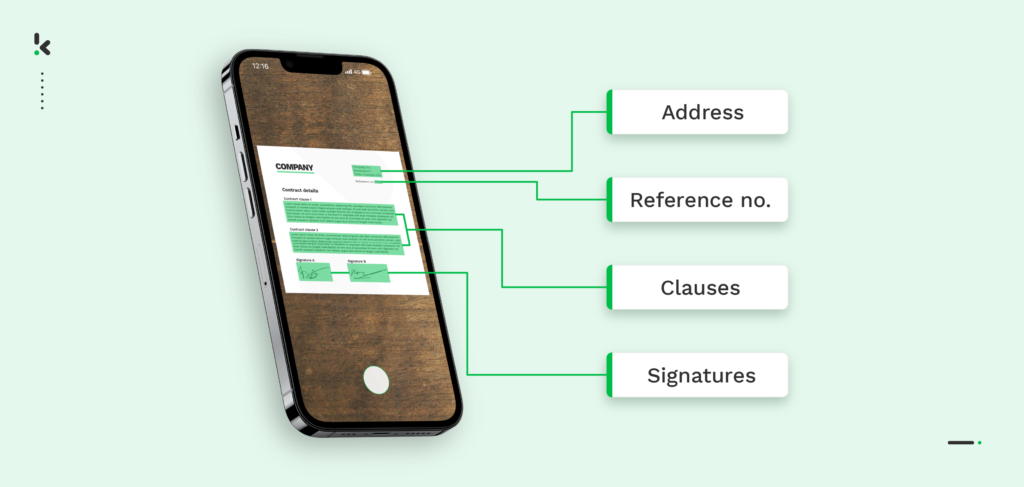
- AI-Powered Data Extraction – Automates identification of key fields such as contract clauses, parties, effective dates, renewal terms, and signatures, reducing manual tagging.
- Integration with CLM Systems – Seamlessly connects to Contract Lifecycle Management platforms, CRMs, and ERPs to enable automated workflows.
- Robust Security & Compliance Controls – Protects sensitive legal data with encryption, role-based access, and adherence to GDPR, HIPAA, and ISO standards.
Tip: Combining these features in a single platform ensures faster onboarding, more accurate clause review, and smooth alignment with compliance and contract lifecycle processes.
Use Cases of OCR in Contract Management
Here are some of the most common use cases where OCR plays an important role in streamlining contract management processes.
Data Extraction and Metadata Tagging
Key fields like names, dates, financial terms, and clauses are identified and extracted automatically. Then OCR creates metadata labels for easy categorization, quick search, and effective retrieval.
Contract Comparison
With OCR, companies can digitize multiple versions of the contracts, making it easier to compare changes between the different versions. This feature allows smoother negotiations that lead to transparency and accuracy
Contract Classification
Contract classification is achieved by organizing and managing contracts based on their content and type. For example, non-disclosure agreements (NDAs), employment contracts, service agreements, or intellectual property agreements. This helps companies manage large amounts of contracts efficiently.
Contract Expiration and Renewal
Expiration dates or renewal deadlines are first identified and then they automatically trigger alerts, helping companies avoid missed opportunities.
Contract Review and Compliance
By extracting and analyzing data fields, OCR tools help detect discrepancies, ensuring compliance with GDPR.
While numerous OCR solutions are available in the market, Doxis AI.dp stands out as a powerful option for contract processing. In the following section, we’ll explore Doxis’ OCR technology and the multitude of benefits it offers.
Conclusion
Taking advantage of OCR’s capabilities means you’re adapting to a digital future where businesses can simplify workflows, reduce manual errors, and save time and resources while staying ahead of the competition and improving performance. Specifically, when it comes to contract management, leveraging OCR tools improves document management by making it easy to organize, search, and retrieve information quickly.
The Best OCR for Contract Management: Doxis
Do you want to boost efficiency, step up your document processing, and cut operational costs? Then, Doxis’ AI-powered Document OCR is for you! It puts an end to manual data entry, reduces errors, and enhances compliance.
Doxis’ smart OCR software simplifies contract management by capturing, recognizing, and converting scanned contracts into searchable data. All this becomes automatic!
From extracting key details like clauses, expiration dates, or signatures to automating workflows for contract creation, review, and renewal, this AI-powered OCR solution ensures accurate and efficient data extraction to support your contract management processes.
But that’s not all! By choosing Doxis’ solution you get to:
- Accurately extract data fields from a variety of document types with OCR
- Automatically anonymize data and images to ensure full compliance with privacy regulations
- Transform documents into various formats, including CSV, XML, JSON, or PDF
- Leverage SDK and API for seamless integration with your existing software solutions
- Enhance fraud prevention through automated document verification processes
- Efficiently classify and categorize a wide range of document types
- Streamline document processing based on specific data fields
Are you ready to elevate your processes with Doxis? Then contact our experts for additional information or book a free demo down below!
FAQ
Modern OCR tools achieve 95–99% accuracy for high‑quality, consistent layouts. For high‑risk contracts, human validation or AI‑powered confidence scoring should be added to ensure legal precision.
Basic OCR struggles with handwriting. AI‑enhanced OCR with Intelligent Character Recognition (ICR) can capture clear hand‑printed text, but complex cursive or unclear signatures still require manual review.
OCR converts scanned contract text into machine‑readable form. AI/NLP goes further, understanding context, identifying clause types, flagging risks, and providing insights beyond simple transcription.
Yes, provided the platform uses encryption, role‑based access control, and meets compliance standards such as GDPR, HIPAA, and ISO. Always verify the vendor’s security certifications.
OCR outputs structured data (JSON, XML, CSV) that feeds directly into CLM systems, enabling automated alerts, renewal tracking, compliance dashboards, and centralised searchable repositories.
Typical fields include party names, dates, governing law, payment terms, renewal clauses, termination conditions, and key obligations. AI-enhanced OCR can classify clauses by type for faster retrieval.
Limitations include reduced accuracy with low‑quality scans, complex layouts, handwriting, or unusual symbols, and a lack of contextual understanding unless combined with AI/NLP.
Depending on document complexity, OCR can process most standard contracts in seconds per page, far faster than manual review, which may take hours.
Yes, OCR can detect and tag compliance‑related clauses, while integrated AI/NLP can flag non‑standard terms and assist in audit preparation.
Most organisations see time and cost savings within 3–6 months, especially when automating high‑volume contracts. ROI improves further when OCR is integrated into CLM or ERP systems for continuous automation.