

Freight invoices are one of the most underestimated bottlenecks in logistics and transportation.
At first glance, they seem simple: a carrier sends an invoice, your team checks it, approves it, and processes the payment. But in reality, freight invoices are some of the most complex financial documents in your entire supply chain. They include fuel surcharges, accessorial fees, shipment references, customs-related cost separations, multi-page breakdowns, and carrier-specific layouts, and they rarely look the same twice.
If your team is still manually processing freight invoices, you’re likely dealing with slow approvals, hidden overcharges, reconciliation issues, and compliance risks. And as shipment volumes grow, so does the complexity.
That’s where freight invoice data extraction powered by AI and OCR changes everything.
Let’s explore what it is, why it matters, and how automated document processing for logistics & transportation can transform your operations.
Key Takeaways
- Freight invoice data extraction automates the capture of structured data from freight invoices using AI-powered OCR and Intelligent Document Processing (IDP), eliminating manual data entry.
- Manual freight invoice processing increases workload and financial risk, especially due to complex surcharges, variable layouts, and cross-border compliance requirements.
- AI-powered freight invoice OCR understands document structure, enabling accurate extraction from multi-page and carrier-specific invoices without relying on fixed templates.
- Automated validation and matching reduce discrepancies and overpayments, forming the foundation for reliable freight audit and payment automation.
- Klippa DocHorizon helps logistics and finance teams gain real-time control over freight spend by extracting, validating, and integrating invoice data directly into ERP and TMS systems.
What Is Freight Invoice Data Extraction?
Freight invoice data extraction is the automated process of capturing structured data from freight invoices and related logistics documents using AI-powered OCR (Optical Character Recognition) and Intelligent Document Processing (IDP).
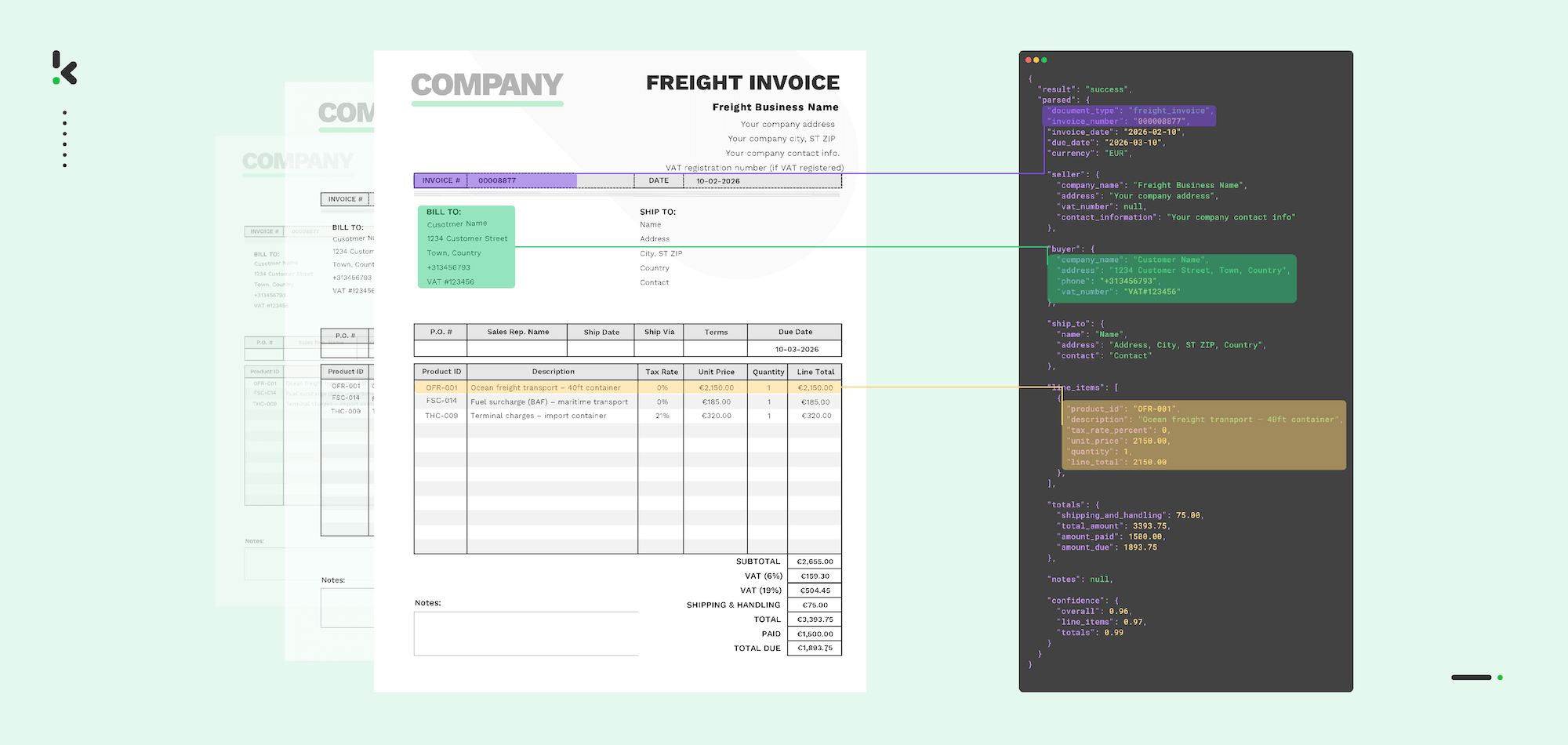
Instead of manually typing invoice data into your ERP or TMS system, AI reads the document, understands its structure, identifies key fields, and converts the information into structured data formats like JSON, XML, or CSV, ready for integration.
Unlike traditional OCR, which simply converts images into text, modern AI-powered systems understand context. They recognize the difference between an invoice number and a shipment ID. They can distinguish between fuel surcharges and base freight rates. They can interpret multi-page documents and variable layouts without relying on fixed templates.
In other words, the technology doesn’t just “read”, it understands.
For your business, that means faster processing, fewer errors, and real-time visibility into freight costs.
The Complexity Behind Freight Invoices
One of the biggest challenges in freight invoice processing is that there is no single global standard.
There is no universal freight invoice template that carriers must follow. Instead, invoice structures are shaped by a mix of commercial agreements, transport modes, tax regulations, and international trade frameworks.
Freight invoices are influenced by:
- Incoterms® (defined by the International Chamber of Commerce)
- Customs valuation standards (World Customs Organization)
- Electronic data models (UN/CEFACT)
- Air cargo billing structures (IATA)
- Local VAT and tax legislation
For example, Incoterms determine who is responsible for freight costs. Under DDP, the seller may invoice freight, while under EXW, the buyer may handle transport separately. Customs regulations often require freight charges to be clearly separated from goods value. In the EU, VAT treatment depends on cross-border rules and zero-rating mechanisms.
All of this means your team is effectively navigating international trade compliance every time they process a freight invoice.
This lack of standardization is precisely why manual processing becomes inefficient and risky.
The Hidden Costs of Manual Freight Invoice Processing
Manual freight invoice handling increases administrative workload while putting pressure on your profit margins.
1. Discrepancies and Overcharges Are Hard to Detect
Freight invoices frequently include complex cost structures: fuel surcharges that fluctuate monthly, accessorial charges for liftgates or residential deliveries, zone-based pricing, dimensional weight adjustments, and more.
Without automation, identifying incorrect charges requires line-by-line verification. In high-volume logistics environments, this makes it difficult to consistently detect inconsistencies before payment is processed.
Even small billing errors can accumulate over time, directly impacting your freight spend.
2. Administrative Workload Slows Your Teams Down
Manual processing demands significant time from your logistics and finance teams.
Employees may spend hours entering invoice data, matching invoices to bills of lading, verifying VAT numbers, and reconciling shipment details. These tasks are repetitive and operational in nature, yet they require careful attention to avoid costly mistakes.
As shipment volumes grow, this administrative burden increases proportionally, making the process harder to scale efficiently.
3. Payment Delays and Compliance Risks Increase
Slow invoice processing often leads to delayed approvals and late payments. This can strain carrier relationships and weaken your position during contract negotiations.
In cross-border logistics, inaccurate or incomplete invoice data may also affect customs declarations or VAT treatment. Errors in documentation can result in additional checks, clearance delays, or compliance exposure.
When you look at the full picture, manual freight invoice processing becomes a financial risk rather than just an operational inefficiency.
How AI-Powered Freight Invoice OCR Works
Modern freight invoice automation follows a structured, intelligent workflow. While the technology behind it is advanced, the process itself can be broken down into four clear steps.
Step 1: Documents Are Ingested into the System
The process starts with document intake.
Freight invoices and related logistics documents can enter the system through multiple channels, depending on how your organization operates. These may include email attachments, API integrations, web uploads, FTP transfers, batch processing, or even real-time mobile scanning using an SDK.
The system supports a wide range of file formats — including PDFs, scanned images, and digital documents such as JPG, PNG, HEIC, DOCX, or XLSX files.
This flexibility ensures that no matter how your carriers send invoices, they can be processed without requiring format standardization on your end.
Step 2: AI Extracts and Understands the Data
Once the document is uploaded, AI-powered OCR begins analyzing it.
Using computer vision and machine learning, the software identifies key invoice components such as carrier details, shipment IDs, invoice numbers, pickup and delivery dates, line items, fuel surcharges, tax amounts, and total charges.
Unlike traditional rule-based systems, modern freight invoice OCR does not rely on fixed templates. Instead, it understands document structure and context. This means it can process invoices from multiple carriers, each with different layouts, without manual configuration.
The result is accurate, structured data extracted in seconds.
Step 3: Automated Data Validation and Fraud Detection
Data extraction alone isn’t enough. Validation is what makes automation reliable.
Advanced freight invoice automation systems automatically verify the extracted information. They can:
- Detect fraud
- Detect duplicate invoices
- Flag missing or low-confidence fields
- Verify VAT numbers through external databases
- Cross-check invoice data against purchase orders or freight contracts
- Identify suspicious document metadata patterns
Some platforms enable 2-way or 3-way matching to ensure that invoiced charges align with agreed rates and shipment records.
This step significantly reduces the risk of overpayments, compliance issues, and fraudulent activity.
Step 4: Structured Data Export and System Integration
After extraction and validation, the structured data is ready for use.
The system exports the data in business-ready formats such as JSON, XML, CSV, UBL, or Excel. From there, it can be automatically pushed into your ERP, TMS, freight audit tool, or accounting software via API integration.
Because the data flows directly into your existing systems, manual re-entry is eliminated. This not only accelerates your workflow but also ensures consistency across departments.
The entire process, from document upload to structured data output, can take just seconds per invoice.
The result is not just faster processing, but a fundamentally more reliable freight audit and payment process.
What Data Can Be Extracted?
A modern Freight Invoice OCR solution can extract dozens, sometimes over 100, structured data fields. These typically include:
- Carrier and billing information
- Invoice numbers and issue dates
- Shipment references
- Container or seal numbers
- Origin and destination details
- Fuel surcharges
- Accessorial fees
- VAT amounts
- Line items
- Total charges
This structured data becomes the backbone of freight audit automation. It enables you to compare invoiced charges with agreed contract rates, detect anomalies, and generate real-time spend insights.
Instead of reacting to cost overruns, your business can proactively control freight spend.
Use Case: How GLS Automated Freight Invoice Processing at Scale
GLS, one of Europe’s leading logistics providers, processes a high volume of import-related invoices across multiple markets. With thousands of shipments moving daily, invoice handling plays a critical role in maintaining financial control and operational efficiency.
Before automation, GLS relied on manual data entry to process freight invoices. Tax office employees had to review invoices, extract key data fields, verify compliance requirements, and manually input information into accounting systems. As invoice volumes increased, this approach became time-intensive and prone to human error.
To improve efficiency, GLS implemented Klippa’s AI-powered invoice data extraction solution. Using intelligent OCR technology, key invoice data was automatically captured and validated before entering their tax and accounting systems. The solution integrated seamlessly into existing workflows without requiring major infrastructure changes.
The impact was immediate:
- Faster invoice approvals and processing times
- Increased accuracy and reduced manual errors
- Improved compliance with tax regulations
- Reduced operational workload for finance teams
By automating freight invoice data extraction, GLS transformed invoice handling from a manual bottleneck into a streamlined, scalable process, enabling their teams to focus on higher-value financial oversight instead of repetitive data entry.
Beyond Freight Invoices: Full Automation for Logistics & Customs
Freight invoices are only one part of your document ecosystem.
In logistics and transportation, your workflows likely involve bills of lading, air waybills, CMR waybills, customs declarations, T1/T2 documents, dangerous goods declarations, and certificates of origin.
This is where automated document processing for logistics and transportation evolves into something bigger.
An AI agent for logistics and supply chain workflows can automatically classify documents, extract structured customs data, separate freight from goods value for compliance, and verify document authenticity using advanced fraud detection algorithms.
For companies managing cross-border shipments, this becomes even more critical. Regulatory initiatives such as the EU’s Import Control System 2 (ICS2) increase the demand for accurate, structured shipment data submitted within strict timelines. Having automated access to validated freight and transport data helps reduce the risk of delays, additional customs checks, or rejected filings.
With automated document processing for customs, clearance processes become faster, compliance risks decrease, and documentation workflows become more predictable.
Instead of managing documents reactively, your business gains real-time control over your logistics documentation landscape.
How Klippa Helps You Automate Freight Invoice Data Extraction
Freight invoices are complex, inconsistent, and time-consuming to process manually. Klippa DocHorizon simplifies this by turning unstructured freight invoices into structured, business-ready data within seconds.
By combining advanced OCR with Intelligent Document Processing (IDP), Klippa automatically extracts and validates key data fields, from shipment IDs and accessorial charges to VAT amounts and total costs, without relying on fixed templates.
Why choose Klippa for Freight Invoice Data Extraction?
- Up to 99% data extraction accuracy
- Support for freight invoices, Bills of Lading, AWBs, and other logistics documents
- Automated validation and fraud detection
- Structured output (JSON, XML, CSV, UBL) ready for ERP or TMS integration
- Fast implementation via API or SDK
With Klippa, you can reduce manual workload, accelerate freight audit workflows, improve compliance, and gain real-time control over your freight spend.
Ready to modernize your freight invoice processing? Schedule a demo or contact us and discover how AI-powered automation can streamline your logistics operations.
FAQ
Freight invoice data extraction is the automated process of capturing structured information from freight invoices using AI-powered OCR and Intelligent Document Processing. The extracted data can then be integrated into ERP, TMS, or accounting systems without manual entry.
2. What data fields can be extracted from freight invoices?
Commonly extracted fields include carrier details, invoice numbers, shipment references, container IDs, pickup and delivery dates, fuel surcharges, accessorial fees, VAT amounts, line items, and total charges. Advanced solutions can extract over 100 structured data fields.
3. Can freight invoice data extraction support freight audit automation?
Yes. Structured invoice data allows you to compare invoiced charges against agreed contract rates, identify discrepancies, detect duplicate invoices, and automate freight audit and payment workflows.
4. Is freight invoice automation useful for international shipments?
Absolutely. Cross-border shipments often require accurate, structured data for customs declarations and regulatory compliance. Automation helps reduce errors and supports initiatives such as the EU’s Import Control System 2 (ICS2), where timely and accurate shipment data is critical.
5. How accurate is AI-powered freight invoice data extraction?
Modern Intelligent Document Processing solutions can achieve data extraction accuracy of up to 99%, depending on document quality and complexity. Validation mechanisms further improve reliability by flagging low-confidence fields.
6. How can freight invoice OCR integrate with existing systems?
Freight invoice OCR solutions typically integrate via API or SDK. Extracted data can be exported in structured formats such as JSON, XML, CSV, or UBL and automatically pushed into ERP, TMS, or accounting platforms.