
Documents pile up fast. Invoices from suppliers, contracts from legal, ID documents from HR, delivery notes from operations: every department in your organization handles paper and PDFs that need to be read, processed, and filed. Doing that manually ties up staff, introduces errors, and slows down the workflows your business depends on.
According to McKinsey Global Institute (2023), employees spend up to 1.8 hours every day searching for and gathering information from documents. Across a team of 10, that adds up to more than two full working days lost every week to tasks that software handles in seconds.
OCR software fixes this by converting documents into structured, machine-readable data and feeding it directly into your systems. This guide covers the best OCR software solutions available in the BENELUX, so your teams in finance, operations, and IT make the right choice for your business.
Key Takeaways
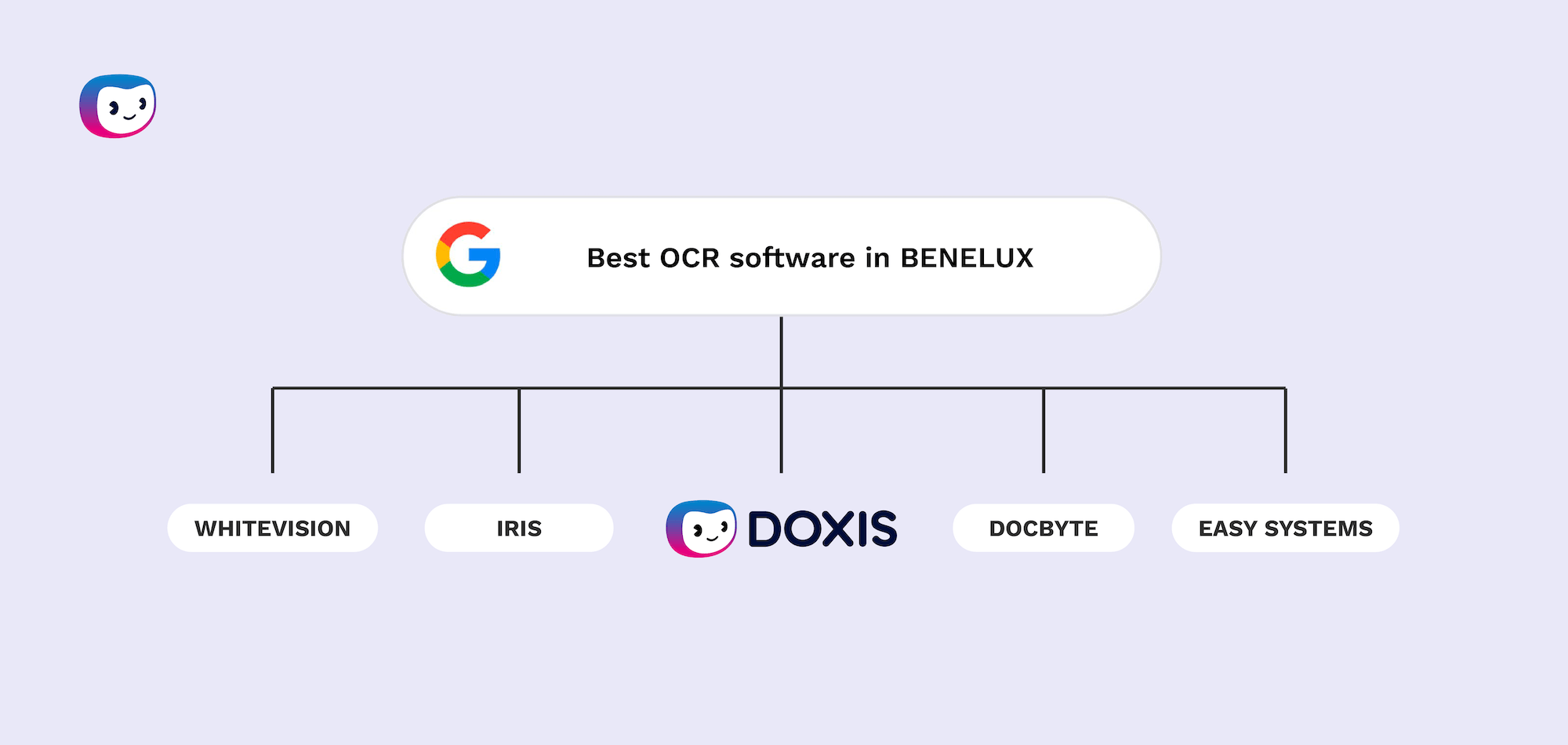
The 5 Best OCR Software Solutions in the BENELUX are:
- Doxis AI.dp (formerly Klippa DocHorizon): is our top choice for 2026 🏆 Leads for organizations that need a full-stack, API-first document processing platform with built-in fraud detection and 99%+ accuracy
- WhiteVision: is built for Dutch and Belgian mid-market companies running Exact or AFAS, with a self-learning OCR model that requires zero template setup
- IRIS (Readiris / IRISXtract): is a Belgian-born OCR technology with 35+ years of development, best suited for document conversion, on-premise deployments, and scanner-based workflows
- Docbyte: is known to work with for regulated industries, combining intelligent document processing with world-first certified digital archiving for finance, insurance, and the public sector
- Easy Systems: is a Dutch P2P automation specialist with solid invoice OCR, built for organizations that want to automate their entire purchase-to-pay process in one platform
What is OCR Software?
OCR software (Optical Character Recognition) converts scanned documents, images, and PDFs into structured, machine-readable data. It identifies and extracts text from any document type, including invoices, contracts, forms, ID documents, and receipts, and feeds that data into your business systems. Modern OCR software combines character recognition with AI to handle varied layouts and document types without manual template configuration.
What to Look for in OCR Software
Choosing the right OCR software depends on what your business actually processes and where your workflow bottlenecks are. A small accounts payable team and a large logistics operation have very different requirements.
These are the capabilities that matter most when evaluating OCR solutions for your business:
- Extraction accuracy: Aim for software that delivers 95%+ accuracy across your document types from day one, without weeks of template configuration.
- Document variety: The best platforms handle invoices, contracts, identity documents, delivery notes, and forms within a single workflow, rather than requiring separate solutions per document type.
- ERP, DMS, and CRM integrations: Your OCR software should push structured data directly into the systems your teams already use, whether that is SAP, AFAS, Exact, Microsoft Dynamics, Salesforce, or a custom application.
- Workflow automation: Data extraction is the first step. The software should also classify documents, trigger approval flows, route to the right person, and archive on completion.
- Peppol and e-invoicing support: Belgium mandated Peppol for B2B invoicing from January 2026. Dutch government suppliers have been required to use it since 2019. If your business handles invoices, your OCR software needs to support structured e-invoice formats alongside PDF processing.
- GDPR compliance and data residency: Documents processed by OCR software contain personal and commercially sensitive data. Verify that the platform operates under a Data Processing Agreement, stores data on EU servers, and supports data anonymization where required.
- Fraud detection: For finance and compliance teams, AI-powered checks on incoming documents, including IBAN validation, duplicate detection, and tamper analysis, reduce the risk of fraudulent documents entering your workflows.
The Best OCR Software Solutions in the BENELUX
Each solution below serves a different type of organization. Here is a close look at what each platform does well and which teams it suits best.
1. Doxis AI.dp (formerly Klippa DocHorizon)
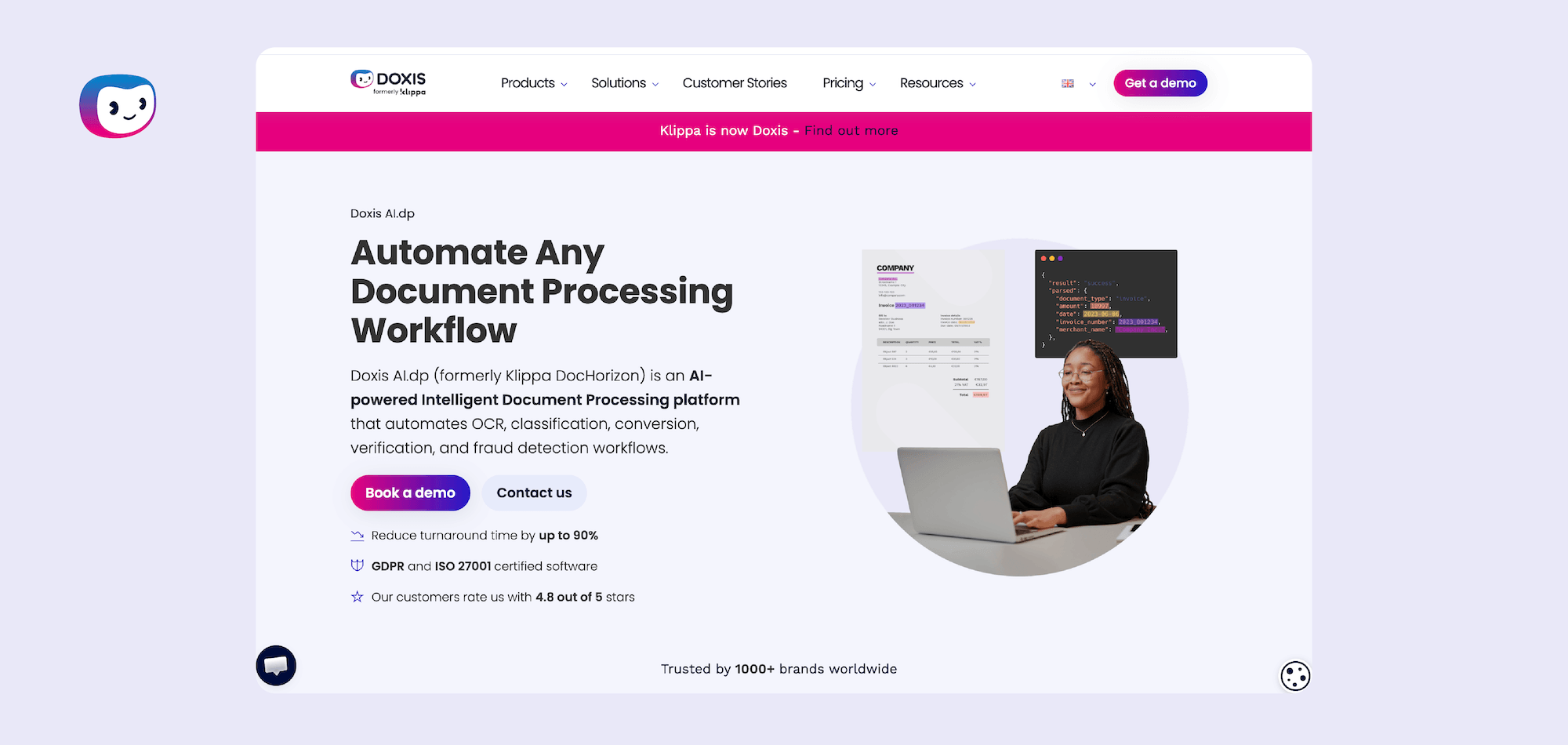
Doxis AI.dp is the Intelligent Document Processing engine of the Doxis platform. Originally built by Klippa, a Dutch AI company founded in Groningen in 2015, the software was acquired by SER Group in March 2025 and fully rebranded as Doxis on March 30, 2026. It now operates as part of Doxis’s unified Document Intelligence platform, which also includes Doxis SpendControl for invoice processing, expense management, and corporate card management.
The platform processes any document in under five seconds, with reported accuracy above 99% across more than 100 document types. Finance teams use it for invoice automation and fraud detection. HR departments use it for identity document processing and onboarding. Operations teams use it to handle delivery notes, purchase orders, and customs documents. The platform’s no-code workflow builder lets each department configure its own document pipeline without IT involvement.
What makes Doxis AI.dp stand out from most OCR platforms is built-in document fraud detection. The software analyzes incoming documents for EXIF anomalies, font inconsistencies, duplicate content, and pixel-level manipulation. For any organization that processes high volumes of external documents, from supplier invoices to onboarding paperwork, this protection is built in from the start rather than bolted on later.
Key capabilities:
- AI-powered extraction from invoices, contracts, receipts, identity documents, purchase orders, delivery notes and many more
- Built-in fraud detection covering IBAN validation, duplicate detection, copy-move analysis, and pixel-level tamper checks
- No-code workflow builder for end-to-end document processing pipelines across departments
- Peppol-certified e-invoicing for the Netherlands and Belgium
- Integration with SAP, Salesforce, Microsoft, and 50+ other platforms via REST API and SDK
- GDPR-compliant processing on ISO-certified servers in Amsterdam by default
- Human-in-the-loop validation for near-100% verified accuracy on complex or high-stakes documents
Limitations:
- No support for non-Latin alphabets out of the box: Non-Latin scripts such as Arabic, Chinese, and Cyrillic require custom configuration.
- Higher setup complexity: The platform’s breadth raises the barrier for smaller teams with limited IT resources.
Best fit: Mid-market and enterprise organizations in BENELUX that process diverse document types across multiple departments and need a single, scalable platform. Especially strong for teams building automated document workflows into their own applications via API.
2. WhiteVision
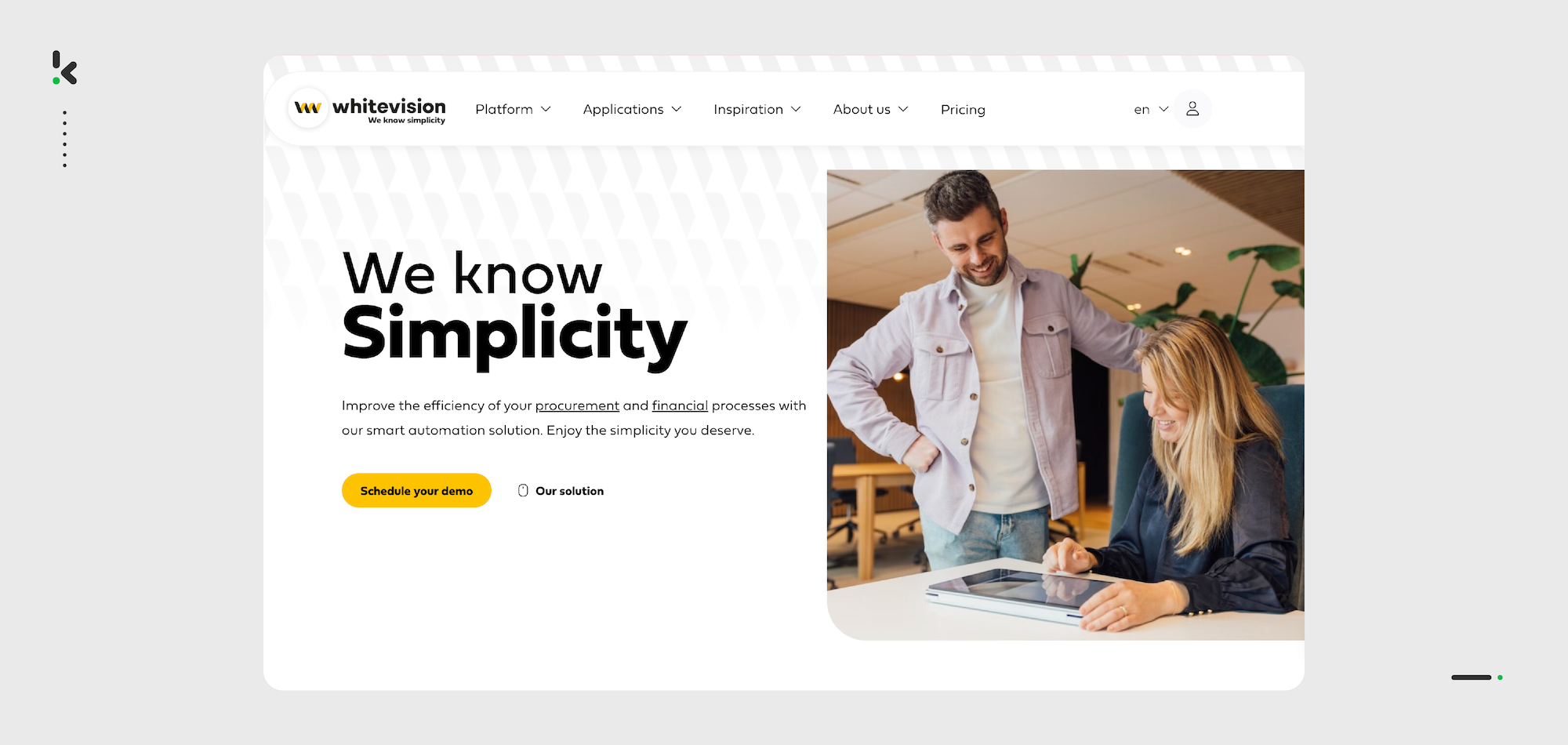
Founded in the Netherlands in 2005, WhiteVision specializes in document processing solutions for finance and procurement teams. The company is best known for its targeted focus on purchase invoice and order automation, serving mid-market organizations. A key differentiator is its self-learning OCR approach, which improves accuracy by leveraging recognition knowledge from its wider user community.
Key capabilities:
- Accepts PDF, paper, XML, and e-invoice formats in a single workflow
- Peppol Access Provider for Belgium and the Netherlands, supporting mandatory e-invoicing compliance
- Deep native integrations with Exact Globe, AFAS, SAP, and other popular Dutch ERP systems
Limitations:
- Narrow document scope: Built specifically for purchase-to-pay documents, making it insufficient for contracts, HR, or logistics workflows.
- No live chat support, annual commitment required: Support runs via phone and email only, and an annual subscription is mandatory from day one.
- Limited financial reporting: The financial overview lacks period filtering, making it harder to get quick insight into invoice flows.
Best fit: Mid-sized Dutch organizations seeking fast, high-accuracy automation for purchase-to-pay workflows.
3. IRIS (Readiris / IRISXtract)
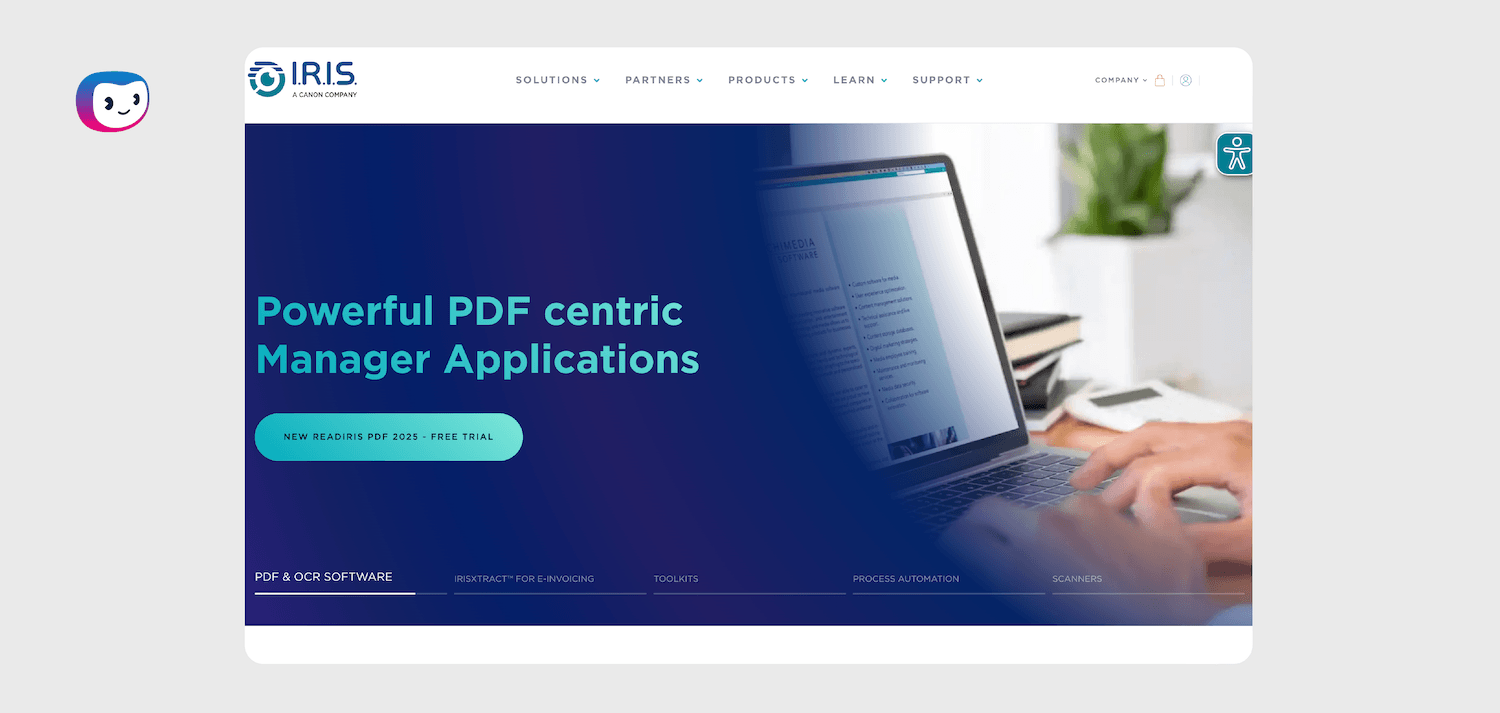
Founded in Belgium in 1987 and now a subsidiary of Canon Europe, IRIS has decades of experience in OCR and document management technology. Its software serves both business teams and developers, offering tools for document conversion, large-scale capture, and data extraction. Known for its extensive language support and ability to run on-premise, IRIS is valued by organizations with strict data sovereignty requirements and established scanning infrastructures.
Key capabilities:
- Readiris PDF converts scanned documents to Word, Excel, PDF, and more with strong layout preservation
- IRISXtract classifies and extracts data from high volumes of incoming documents across business functions
- On-premise deployment available, important for organizations with strict data sovereignty requirements
Limitations:
- No modern API or workflow automation: Readiris is a desktop application with no native REST API, requiring an additional platform for ERP integration or approval routing.
- Lower accuracy on complex or poor-quality scans: Accuracy drops noticeably with handwritten text, complex layouts, or low-quality scans, requiring manual corrections.
- High memory usage and slow loading: Users report loading times of 30–40 seconds for large files, slowing down high-volume workflows.
Best fit: Companies needing dependable document conversion, on-premise OCR deployments, or integration of proven OCR engines into custom-built applications.
4. Docbyte
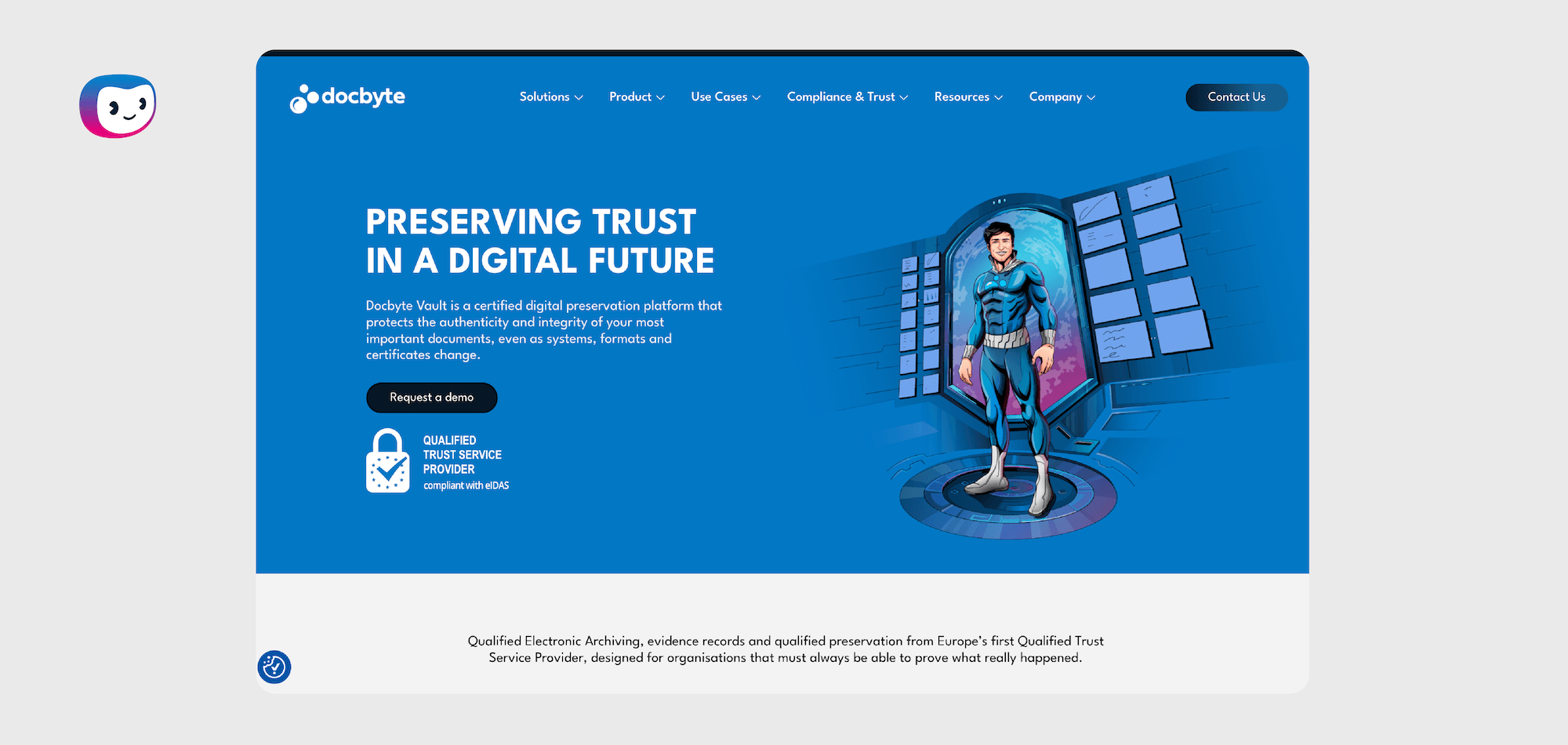
Founded in Ghent, Belgium in 2006, Docbyte focuses on Intelligent Document Processing and secure digital archiving for regulated industries. Known for combining document capture with legally certified preservation, it ensures compliance with strict frameworks such as MiFID II, DORA, AML Regulation, and EU eIDAS. In 2023, Docbyte became the world’s first Qualified Electronic Archiving (QeA) provider, guaranteeing the long-term integrity and authenticity of electronic records.
Key capabilities:
- AI-powered document classification, extraction, and validation for invoices, contracts, compliance documents, and correspondence
- Compliance with DORA, MiFID II, AML Regulation, and EU eIDAS requirements
- Human-in-the-loop validation for high-stakes document workflows such as loan applications, onboarding, and credit checks
Limitations:
- Sized for regulated, larger organizations: For smaller businesses without strict archiving obligations, the solution is likely overspecified and disproportionate in cost.
- Few public user reviews: Docbyte has virtually no public reviews on G2, Capterra, or Gartner Peer Insights, making independent validation difficult.
- Implementation requires specialist involvement: Certified archiving standards and system integrations require active involvement from Docbyte’s own implementation team.
Best fit: Regulated organizations in Belgium and the BENELUX needing both intelligent document processing and certified, compliant long-term archiving in a single solution.
5. Easy Systems (Easy Invoice)
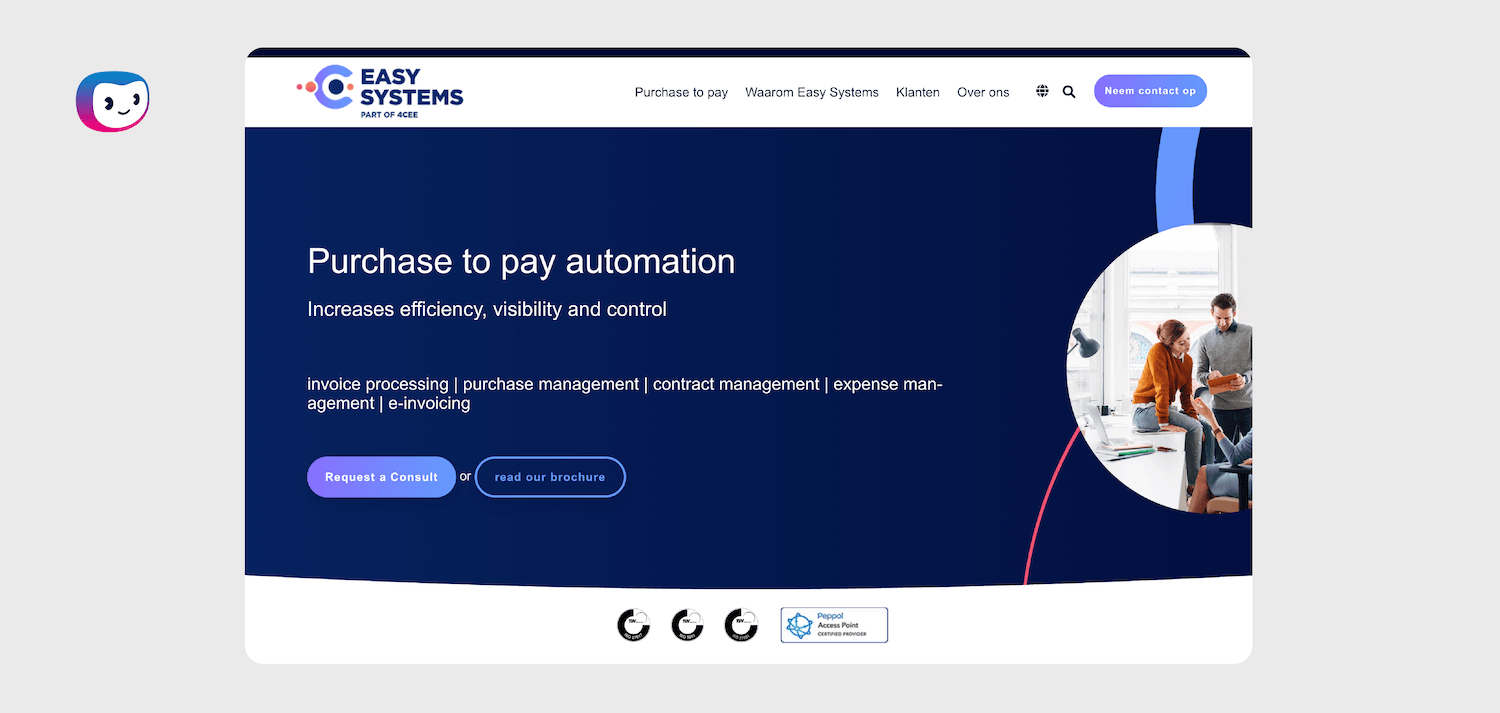
Founded in the Netherlands in 2005, Easy Systems specializes in complete purchase-to-pay (P2P) automation. Unlike many OCR platforms that only handle data extraction, it offers an integrated suite covering everything from document capture and approvals to matching, payment processing, procurement, and contract management, all within a single ERP-independent platform. This allows organizations to connect seamlessly with any financial system, from major ERP solutions to smaller local accounting packages.
Key capabilities:
- OCR scan and capture that automatically extracts document data and delivers it into your workflow
- ERP-independent architecture with standard integrations across common financial and ERP platforms
- Peppol e-invoicing support via Easy Exchange, handling both inbound and outbound e-invoices regardless of file format
Limitations:
- OCR is not self-learning: The AI model is pre-built and does not learn from your data, meaning manual template creation is still needed for suppliers with low recognition rates.
- Primarily focused on the Dutch market: Integrations and support are strongly tailored to Dutch ERP systems, offering less depth for organizations in Belgium, Luxembourg, or with international setups.
- Limited to purchase-to-pay workflows: Teams that also need to process HR documents, contracts, or logistics documents will need a separate platform for those workflows.
Best fit: Dutch SMEs and mid-market businesses aiming to automate their entire purchase-to-pay process in one unified environment, with OCR as part of a broader finance and procurement workflow.
How Doxis Compares
Each solution in this guide serves a specific profile. WhiteVision and Easy Systems are purpose-built for invoice and P2P automation, and both are excellent choices for Dutch SMEs that want fast deployment with minimal IT involvement. IRIS provides deep OCR expertise and on-premise flexibility that suits organizations with data sovereignty requirements or existing Canon infrastructure. Docbyte is the clear choice for regulated Belgian industries that need legally certified archiving alongside document processing.
Doxis AI.dp is the strongest option for organizations that need more than invoice OCR. It covers any document type across any department, connects to 50+ systems via API, and includes fraud detection capabilities that most platforms do not offer at all.
Three capabilities set it apart for organizations building scalable document workflows:
- Breadth: From invoices and contracts to ID documents and delivery notes, a single platform handles your entire document landscape across finance, HR, operations, and IT
- Fraud detection: Purpose-built checks go beyond basic duplicate detection, covering EXIF analysis, pixel-level tamper detection, and IBAN validation. Learn more about how document fraud detection works
- Integration depth: The Doxis AI.dp platform connects document processing directly to workflow automation, ECM, contract lifecycle management, and archiving, eliminating the need for multiple vendors
If your business is ready to move beyond manual document handling, request a free demo and see how a unified document processing platform works in practice.
FAQ
OCR software converts scanned documents, images, and PDFs into structured, machine-readable data. It identifies text, numbers, and fields within a document, extracts them into a structured format such as JSON or XML, and pushes that data into your business systems. Modern OCR software uses AI to handle varied layouts across document types without manual template setup.
2. What is the best OCR software in the BENELUX?
Doxis AI.dp (formerly Klippa DocHorizon) is the most complete all-round OCR and Intelligent Document Processing software in the BENELUX, with high accuracy across 100+ document types, built-in fraud detection, and Peppol e-invoicing support. For SMEs focused on invoice automation, WhiteVision and Easy Systems are strong alternatives. Docbyte is the leading choice for regulated Belgian organizations that require certified digital archiving alongside document processing.
3. Which BENELUX OCR solutions support Peppol e-invoicing?
Doxis, WhiteVision, and Easy Systems are all Peppol-certified in the BENELUX. Belgium made Peppol mandatory for VAT-registered B2B companies from January 1, 2026. Dutch suppliers to government entities have been required to use it since 2019. For a full overview of where each country stands, see our guide to e-invoicing regulations in the EU.
4. How accurate is OCR software for business documents?
Modern AI-powered OCR software achieves 95% to 99%+ field-level accuracy on well-structured documents. Accuracy depends on document quality, layout complexity, and whether the software uses fixed templates or AI-trained models. Platforms like Doxis AI.dp report accuracy above 99% on structured documents, with a human-in-the-loop option for 100% verified output on complex or sensitive files.
5. What is the difference between OCR and Intelligent Document Processing?
OCR converts images of text into machine-readable characters. Intelligent Document Processing (IDP) goes further: it combines OCR with AI, natural language processing, and machine learning to understand document context, classify document types, extract structured fields, and validate data against business rules. For most organizations, IDP delivers more value than standalone OCR because it automates the full workflow, not just the reading step.
6. Does OCR software integrate with SAP, AFAS, Exact, or other ERP systems?
Yes. Most enterprise OCR and IDP platforms in the BENELUX offer native integrations with popular ERP and DMS systems. Doxis connects to SAP, Salesforce, and Microsoft via REST API. WhiteVision has deep integrations with Exact and AFAS. Easy Systems is ERP-independent and provides standard connectors across a wide range of financial platforms. Always verify your specific ERP version is supported during your evaluation.
7. Is OCR software GDPR-compliant for organizations in the BENELUX?
GDPR compliance is a baseline requirement for any OCR software used in the BENELUX. Look for platforms that operate under a Data Processing Agreement, store data on EU-based servers, and support automatic data anonymization or deletion. Doxis processes data on ISO-certified servers in Amsterdam by default and does not store customer data unless specifically configured. Docbyte holds certified Qualified Electronic Archiving status with strict data integrity standards built in.
8. How long does it take to implement OCR software?
Cloud-based platforms like Doxis AI.dp and WhiteVision are set up within days for standard document workflows, with API integrations taking longer depending on system complexity. Platforms with broader workflow scope, such as Easy Systems, require more configuration but deliver greater automation across the full document process. A realistic implementation timeline for a mid-market organization is two to six weeks from kickoff to go-live.