
Paper and PDF documents still dominate day-to-day work in the UK. Contracts from legal teams, VAT invoices for accounts payable, HMRC forms for tax compliance, and receipts from suppliers.
Processing all those documents manually wastes valuable hours and can even put your organisation at risk of non‑compliance with regulations like HMRC’s Making Tax Digital (MTD) requirements.
Optical Character Recognition (OCR) software makes the difference. By converting scanned documents, images, and PDFs into machine-readable, searchable, and editable data, OCR pulls out relevant information and feeds it directly into your business systems.
In this guide, we compare the best OCR software available in the UK for 2026, focusing on accuracy, integrations, and UK-specific features. Whether you need a mobile scanner for on‑the‑go capture, an accounting‑specific OCR for VAT and receipts, or a scalable enterprise solution, you’ll find the right choice here.
Key Takeaways
- Doxis AI.dp – Best overall for enterprise Intelligent Document Processing. Delivers 99%+ OCR accuracy for VAT invoices, HMRC forms, and contracts, with built‑in fraud detection.
- ABBYY FineReader PDF – For multilingual and complex documents. Supports 190+ languages with layout preservation, suitable for legal and international organisations.
- Adobe Acrobat Pro / Adobe Scan – Best for everyday PDF OCR for Adobe Creative Cloud users, plus mobile capture with Adobe Scan.
- Dext – Focused on UK accounting automation. Built for extracting VAT and line items from receipts/invoices with Xero, Sage, and QuickBooks integration.
- AutoEntry – Strong choice for Sage users. Automates financial document processing within Sage 50, 200, and Sage Business Cloud.
- Readiris 17 – Reliable OCR in 138 languages with a one-time purchase model, no recurring fees.
- Tesseract OCR – Best open-source tool for developers. Highly customizable OCR engine for building self-hosted solutions.
What is OCR Software?
Optical Character Recognition (OCR) software is a technology that converts scanned documents, images, and PDFs into machine-readable, searchable, and editable text.
When you scan a VAT invoice, HMRC form, contract, or receipt, the OCR engine analyses the shapes and patterns of the characters, matches them against known fonts and language sets, and outputs structured text that can be stored, searched, or processed by your business systems like SAP, Sage, SharePoint, or a custom ERP.
Best OCR Software in the UK (2026)
1. Doxis AI.dp (formerly Klippa DocHorizon)
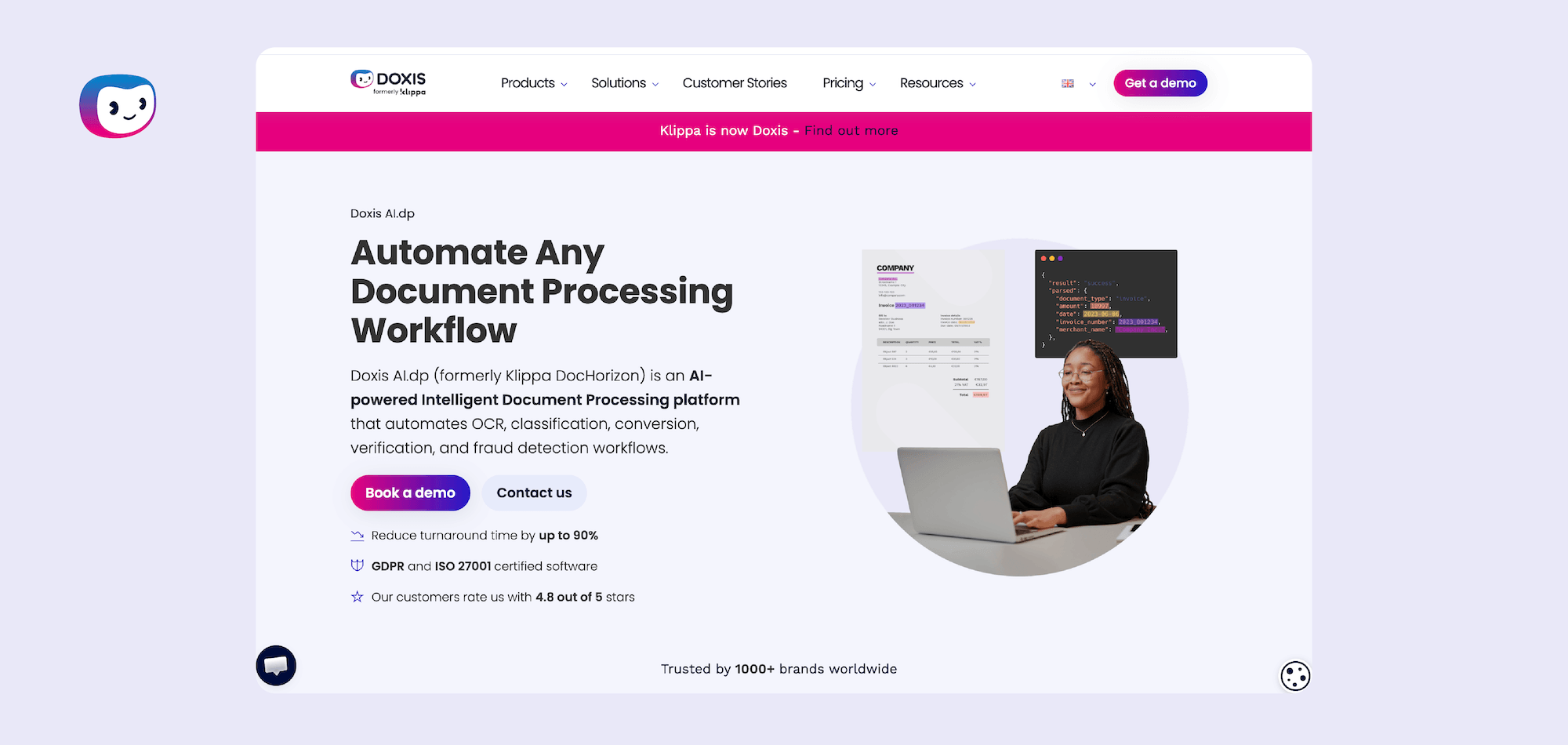
Doxis AI.dp is an advanced IDP solution built for UK enterprises that need OCR as part of a wider automation ecosystem. It delivers 99%+ field-level accuracy across over 100 document types, including VAT invoices, receipts, HMRC forms, bank statements, identity documents, contracts, and more – processing documents in under five seconds and routing them to your desired system.
What makes Doxis AI.dp stand out from most OCR platforms is its built-in document fraud detection features. The software analyses incoming documents for generative AI, EXIF anomalies, font inconsistencies, duplicate content, and pixel-level manipulation.
Doxis AI.dp is available as a standalone software or as the OCR and IDP engine within the wider Doxis platform – a recognised Leader in the Gartner® Magic Quadrant™ for Document Management. It is GDPR and UK Data Protection Act 2018-compliant, making it a top OCR choice for UK organisations in 2026.
Key capabilities:
- AI-powered OCR across 100+ document types without manual template setup
- Built-in fraud detection: UK bank account number validation (IBAN, sort code checks), copy-move analysis, EXIF anomaly checks, and more
- Automated document conversion and classification for VAT invoices, HMRC returns, purchase orders, and contracts
- No-code workflow builder for department-specific document pipelines (finance, HR, operations)
- API & SDK integrations with Xero, Sage 50 & 200, QuickBooks UK, SAP, Microsoft Dynamics 365, Salesforce, SharePoint, and 200+ other systems
- GDPR and SOC I & II -compliant processing on 27001 ISO-certified servers
- Human-in-the-loop validation for 100% verified accuracy in sensitive workflows
Limitations:
- No native support for non-Latin scripts (e.g., Arabic, Chinese, Cyrillic) without custom configuration
- A broader setup scope may require IT resources for smaller teams without dedicated technical staff
Best fit: Mid-market to enterprise organisations in UK finance, public sector, healthcare (NHS), manufacturing, and logistics with complex document workflows, especially those requiring VAT compliance, fraud detection, and integration with UK accounting platforms.
2. ABBYY FineReader PDF
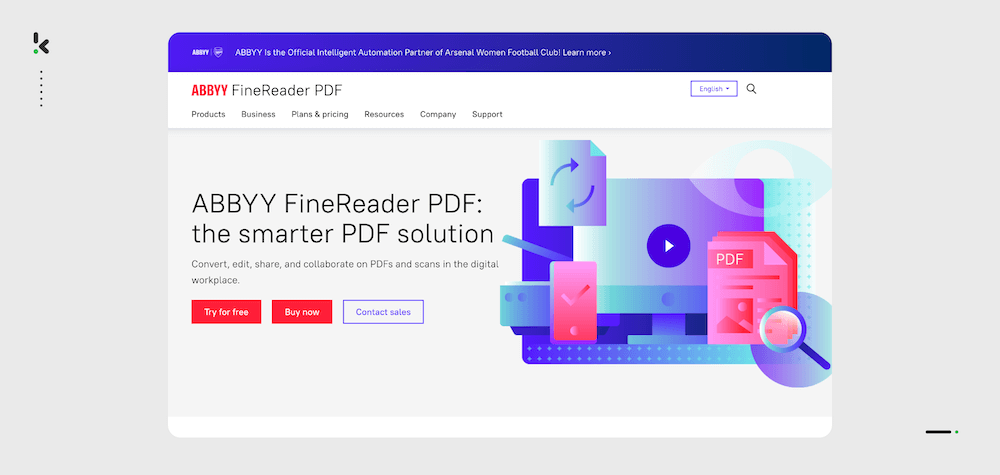
ABBYY FineReader PDF is an OCR platform that combines text recognition with PDF editing in a single desktop application. It supports over 190 languages and can process scanned documents, image-based PDFs, and mixed-content files. FineReader PDF is available in both Windows and macOS editions, with an enterprise deployment option for larger organisations.
Key Advantages:
- OCR across 190+ languages, including Arabic, Chinese, and Cyrillic
- Preserves document structure (headers, footnotes, tables) across multi-page documents
- PDF editor with annotation, redaction, form filling, and digital signature support
- Available as a cloud or on-premise solution
- Table recognition that exports to Excel with preserved formatting
Limitations:
- Desktop-first architecture means no native real-time API access for developers building custom integrations into UK business systems such as Sage or Xero
- Higher per-seat pricing compared to cloud-based alternatives – licensing can be complex for large enterprise teams
Best Fit: UK legal firms that need OCR for complex, multilingual documents and prefer a self-contained desktop or on-premises solution without cloud dependency.
3. Adobe Acrobat Pro / Adobe Scan
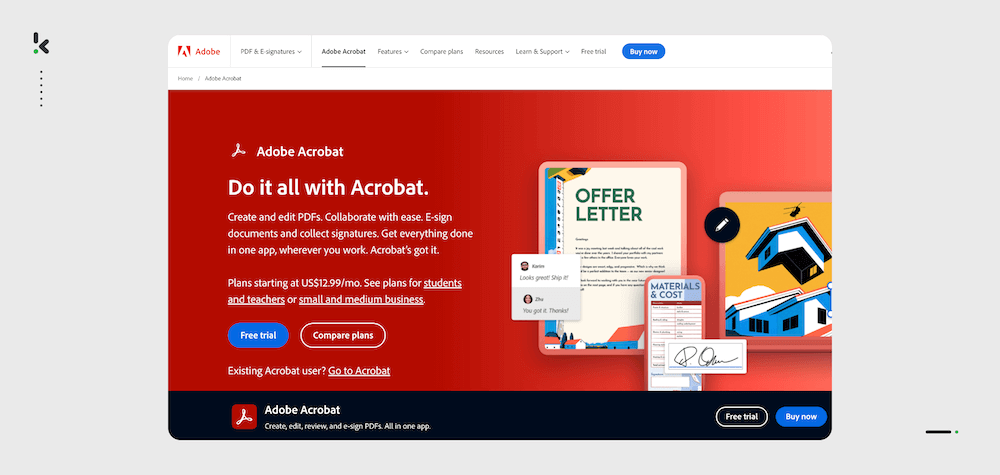
Adobe Acrobat Pro is a PDF tool with built-in OCR (called “Make Searchable PDF”), offering tight integration across the Adobe ecosystem. Adobe Scan, its mobile companion app, lets users capture documents with a smartphone camera and instantly convert them into searchable PDFs.
Key Advantages:
- Universal format compatibility: virtually every PDF produced anywhere can be opened, edited, and scanned in Acrobat
- Adobe Scan offers mobile capture with automatic edge detection and perspective correction
- Integrations with Microsoft 365, SharePoint, Google Drive, and Adobe Creative Cloud
- E-signature workflows built natively via Adobe Acrobat Sign, supporting UK eIDAS-aligned electronic signature requirements
- Acrobat AI Assistant allows users to query document content using natural language
Limitations:
- Subscription pricing via Adobe Creative Cloud can be expensive for organisations needing only Adobe Acrobat Pro OCR functionality
- Acrobat’s primary strength lies in PDF editing and workflow integration rather than raw OCR performance; users processing low-quality or aged scans frequently report the need for manual corrections after recognition. (Adobe Community)
Best Fit: UK organisations already using Adobe Creative Cloud or Microsoft 365 that need reliable PDF OCR without introducing a new vendor.
4. Dext (formerly Receipt Bank)
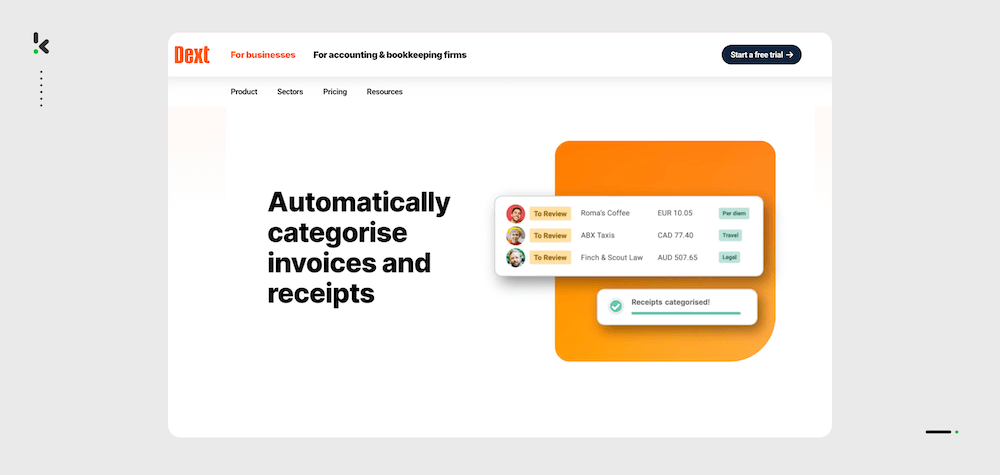
Dext is a UK-founded document capture and data extraction platform purpose-built for accounting and bookkeeping workflows. It automatically captures data from supplier invoices, receipts, and bank statements, then pushes the extracted data directly into cloud accounting platforms.
Key Advantages:
- Purpose-built for UK accounting workflows: extracts VAT figures, supplier details, and line items from invoices and receipts
- Direct integrations with Xero, QuickBooks, Sage 50 & 200, FreeAgent, and KashFlow
- Mobile app allows users to capture receipts on the go
- Supplier rules and auto-categorisation learn from historical data
- Supports multi-currency processing
Limitations:
- Primarily focused on financial documents (invoices, receipts, bank statements) – not suitable as a general-purpose OCR tool for contracts, correspondence, or identity documents
- Pricing tiers based on document volume can become costly for high-transaction SMEs processing hundreds of documents monthly
Best Fit: UK SMEs, sole traders, and accounting practices looking to automate bookkeeping data entry from invoices, receipts, and expense documents. Particularly well-suited to Xero or QuickBooks users.
5. AutoEntry (by Sage)
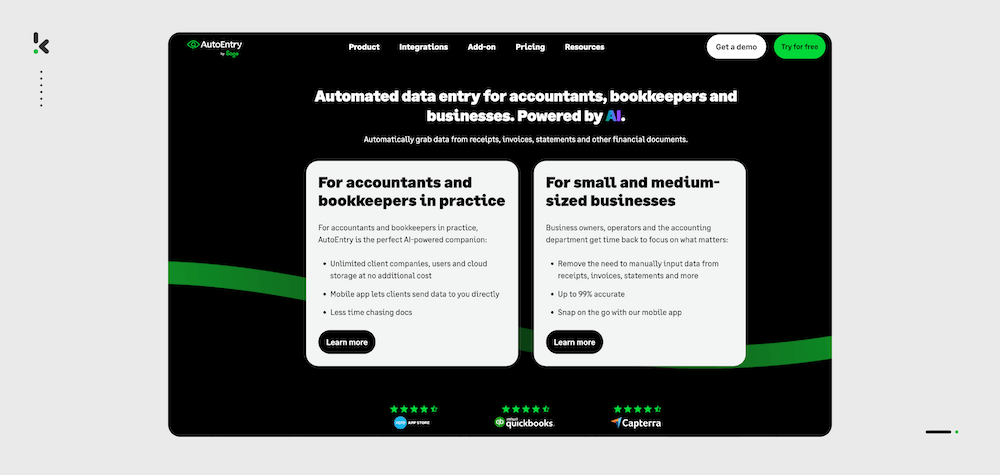
AutoEntry is a Sage-owned cloud-based data capture and OCR platform designed to automate the extraction of financial data from invoices, receipts, expenses, and bank statements. It integrates directly with Sage’s own accounting products, such as Sage 50, Sage 200, and Sage Business Cloud, as well as third-party platforms.
Key Advantages:
- Native integration with Sage 50, Sage 200, and Sage Business Cloud
- Automates extraction of UK-relevant financial fields: VAT codes, net/gross totals, supplier references, and payment terms
- Supports purchase invoices, sales invoices, receipts, expenses, and bank statements
- Cloud-based with no software installation required
- Automated supplier matching and line-item learning
Limitations:
- Primarily limited to financial document types – not a general-purpose OCR tool for contracts, HR documents, or correspondence
- Users on non-Sage accounting platforms report that integrations can occasionally require manual reconciliation, and the tool’s strengths are most pronounced within the Sage ecosystem (Trustpilot)
Best Fit: UK SMEs and accounting practices already using Sage products that want a tightly integrated, low-setup document capture solution for purchase invoices, receipts, and expense processing.
6. Readiris 17
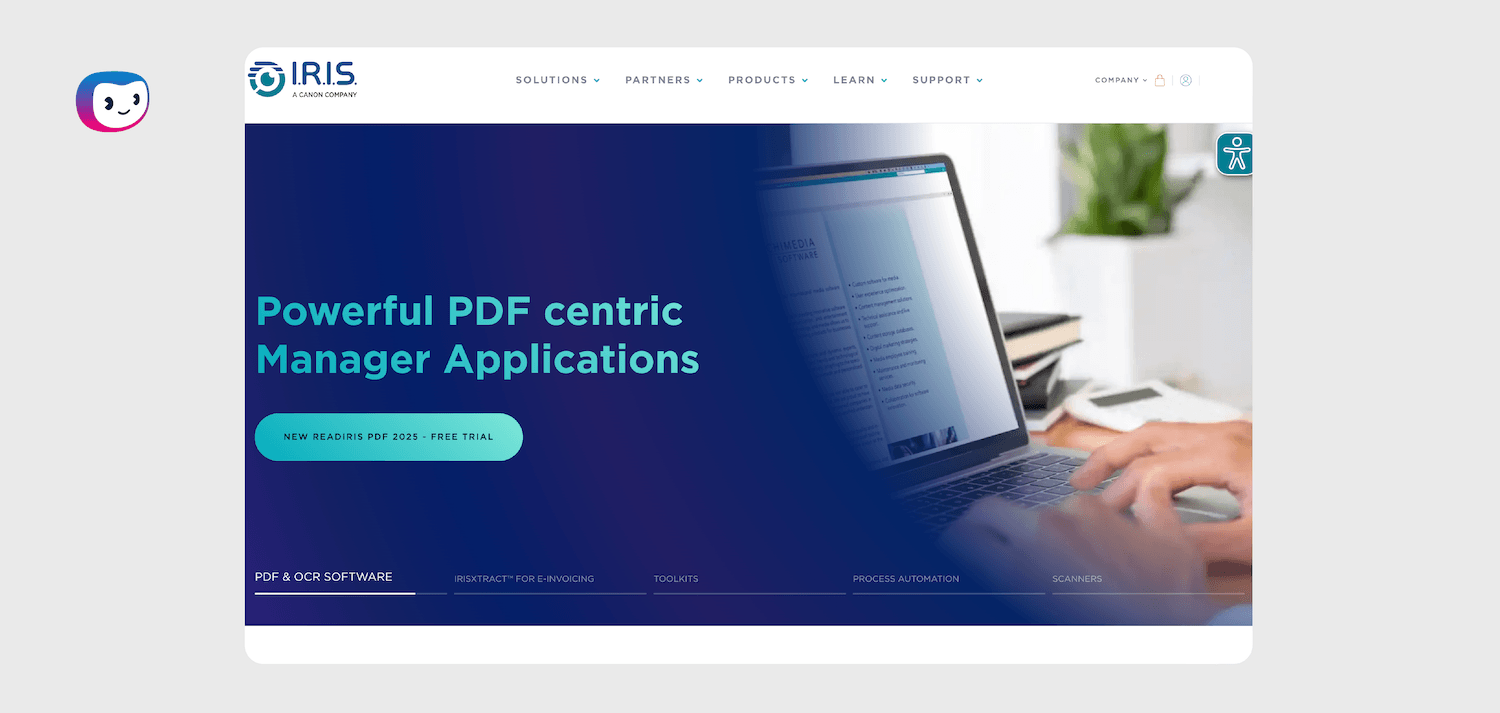
Readiris 17 is a dedicated OCR and PDF management application from IRIS Group (a Canon company), positioned as an accessible, one-time-purchase alternative to subscription-based tools. It covers core OCR functionality across 138 languages, PDF creation and editing, and basic document conversion.
Key Advantages:
- One-time purchase model with no recurring subscription fees
- Supports 138 recognition languages with accuracy on clean, well-structured documents
- Includes AI-powered document summarisation for quick content extraction
- Converts scanned documents to editable Word, Excel, and searchable PDF formats
- Lightweight installation with minimal system requirements compared to enterprise OCR platforms
Limitations:
- Recognition accuracy on low-resolution scans, handwriting, or complex table layouts is noticeably weaker than dedicated cloud OCR APIs (Capterra)
- Limited API or automation capabilities, not suited for integration into custom developer workflows or high-volume batch processing pipelines
Best Fit: UK freelancers, sole traders, and small businesses that need straightforward OCR for standard office documents and prefer a one-time purchase over a SaaS subscription.
7. Tesseract OCR
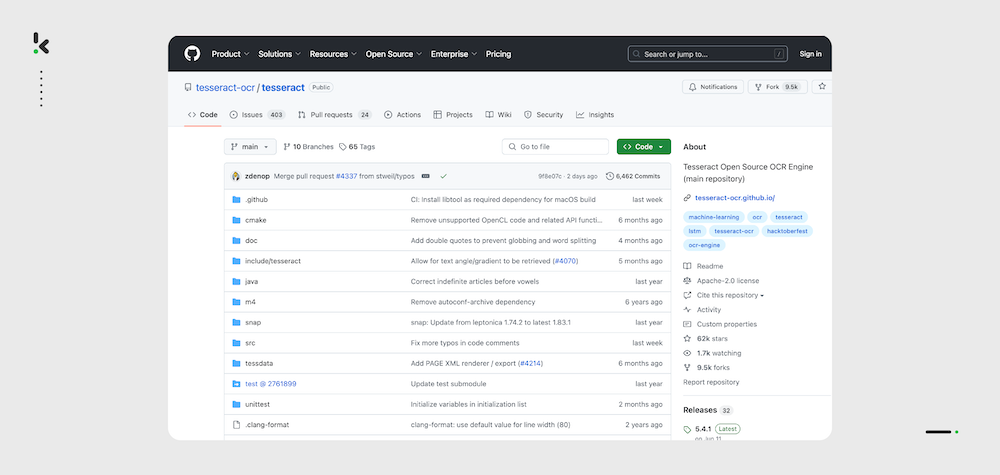
Tesseract is an open-source OCR engine originally developed by HP and now maintained by Google. It is the foundation layer for a large share of OCR tooling in the developer ecosystem, used directly or embedded within commercial products, cloud platforms, and custom-built document processing pipelines. Its primary audience is developers and data engineers.
Key Advantages:
- Completely free and open source under Apache 2.0, no licensing costs or usage caps
- Supports 100+ languages with an LSTM-based neural network recognition engine
- Highly customizable: can be fine-tuned with custom training data for domain-specific fonts or UK-specific document types
- Integrates into virtually any tech stack via Python (pytesseract), Java, C++, and other wrappers
- Full data residency control: ideal for organisations with strict data sovereignty requirements under UK GDPR
Limitations:
- Requires developer expertise to deploy effectively: image preprocessing, DPI normalisation, and output post-processing are often necessary to achieve production-grade accuracy
- No built-in support for structured data extraction (e.g., VAT invoice line items, UK-format dates) without additional custom logic
Best Fit: UK development teams, data engineers, and public-sector technology units building custom OCR pipelines who need a cost-free, self-hosted engine with full UK GDPR data-residency control.
How to Choose the Best OCR Software in the UK
The best OCR software for your business depends on more than accuracy ratings alone. Local regulations, industry workflows, and the specific document formats you process all influence the right choice. When evaluating OCR platforms, focus on these key buying factors:
1. Accuracy on Your Document Types
If you process VAT invoices, HMRC forms, or multi-language contracts, ensure the platform can handle these specific formats without misreading key data fields.
For compliance-heavy sectors like finance, legal, and healthcare (NHS), even small recognition errors can cause costly issues. Prioritise solutions with human-in-the-loop verification and reported accuracy above 99% on your documents.
2. Workflow Integration
The most powerful OCR is wasted if it doesn’t connect with your existing systems.
Look for direct integrations or robust APIs into your business tools: Xero, Sage 50 & 200, QuickBooks UK, Microsoft 365 SharePoint, SAP UK, or your ERP/CRM/DMS.
If you’re in accounting, ensure the tool can auto-populate VAT fields, supplier details, and payment terms in your ledger.
3. Regulatory Compliance & Security
UK businesses must comply with GDPR and the UK Data Protection Act 2018, as well as sector-specific frameworks (e.g., FCA compliance for finance).
Choose OCR software that offers UK or EU data residency and ISO 27001 certified hosting.
Ensure encryption in transit and at rest, plus data anonymisation options for sensitive workflows.
4. Pricing Model That Matches Your Usage
- High-volume scanning: Consider subscription APIs where cost scales with usage.
- Occasional use: Opt for tools with one-time licenses to avoid recurring fees.
Factor in setup, training, and integration costs when calculating the total cost of ownership.
5. Advanced Features for Competitive Advantage
Decide which features are essential for your business:
- Fraud detection for procurement and accounts payable (e.g., IBAN/sort code validation, tamper analysis).
- Handwriting recognition (ICR) for processing paper-based forms.
- Automated classification and routing for multi-department document workflows.
6. Scalability & Automation
If your business is growing, choose an OCR that supports:
- Batch processing for large document sets.
- Real-time API calls for live data extraction.
- Integration into broader IDP platforms, so OCR is just one part of an automated, end-to-end workflow.
Before committing, always run a proof-of-concept with a representative sample of your own UK documents, invoices, receipts, and contracts, to assess not just accuracy but speed, integration fit, and usability for your team.
Why UK Enterprises Choose Doxis AI.dp
For many organisations in the UK, OCR is only the first step in a much larger document lifecycle. The real efficiency happens when data from scanned documents flows automatically into ERP systems, triggers downstream processes, and undergoes validation.
Doxis AI.dp delivers exactly that. A single platform that combines:
- 99%+ accuracy OCR, intelligent classification
- Structured data extraction
- Built-in fraud detection
- End-to-end workflow automation
From AP invoices and contracts to bank statements, delivery notes, customs forms, and identity documents, all can be processed within one platform. This reduces the cost and complexity of running separate software for different departments.
In short, more than 1000 companies worldwide choose Doxis AI.dp because it combines gold-standard OCR accuracy with the automation, compliance, and fraud prevention features that large UK organisations require. Because Doxis AI.dp doesn’t stop at reading documents, it makes them instantly useful, trustworthy, and fully integrated into business operations.
Contact our experts for more insight into our OCR software capabilities or book a free demo down below!
FAQ
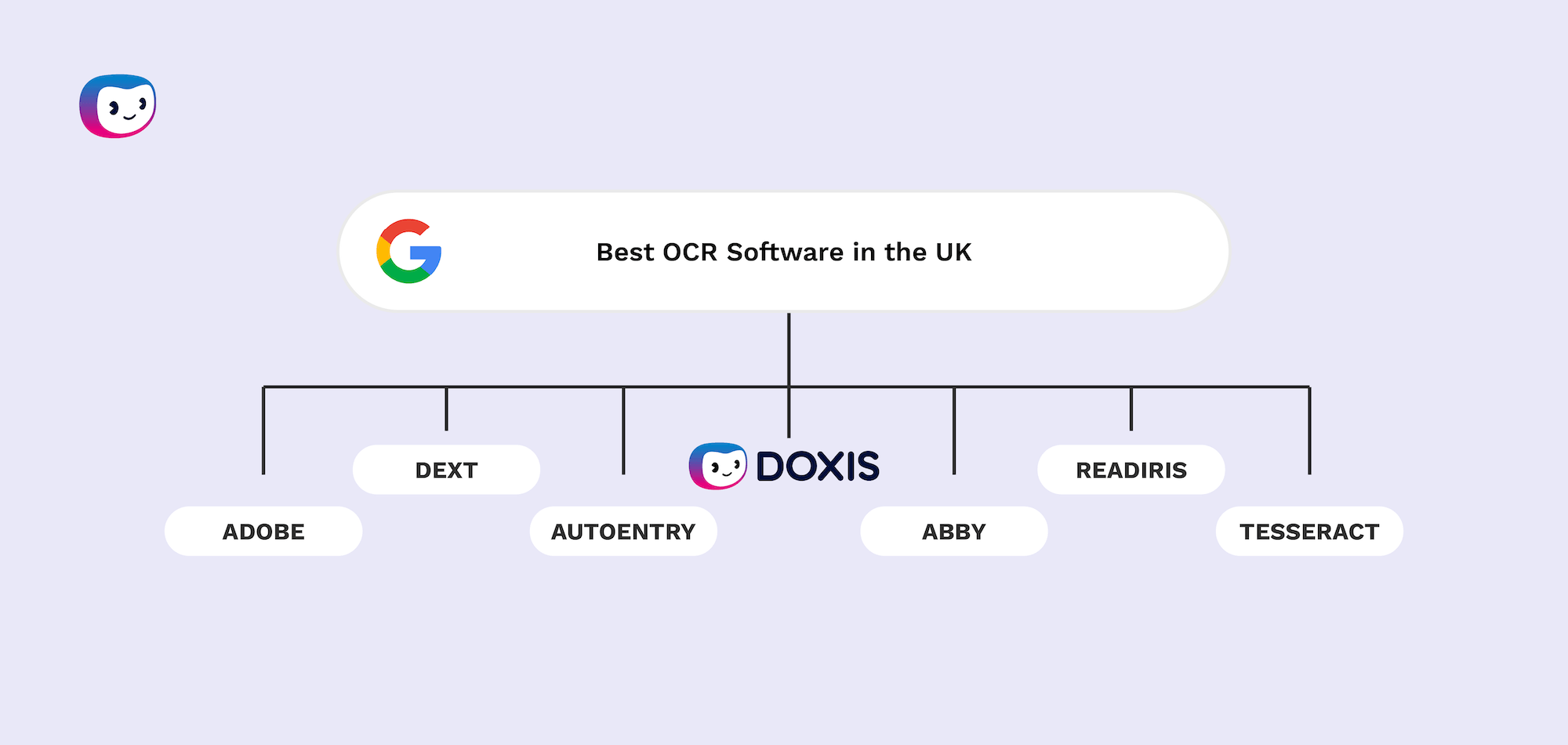
The top OCR software in the UK for 2026 is Doxis AI.dp, ABBYY FineReader PDF, Adobe Acrobat Pro / Adobe, Dext, AutoEntry, Readiris 17, and Tesseract OCR.
For complex and regulated UK documents, Doxis AI.dp consistently deliver field‑level accuracy above 99%. Doxis AI.dp also offers human‑in‑the‑loop verification for 100% guaranteed accuracy in VAT invoices, HMRC returns, and legal contracts.
Doxis AI.dp, Dext, and AutoEntry offer direct integration with Xero and Sage 50 & 200.
For everyday OCR needs, Tesseract OCR is a good free open-source engine – but, unlike platforms like Doxis AI.dp, it requires significant technical know-how to configure and deploy.
Yes. Accounting‑specific OCR tools like Doxis AI.dp can extract VAT totals, net/gross amounts, and correctly identify VAT codes from invoices and receipts, supporting HMRC’s Making Tax Digital (MTD) requirements.
Most enterprise OCR platforms in the UK, including Doxis AI.dp, offer GDPR‑compliant processing. Look for platforms that provide UK/EU hosting, ISO 27001 certification, encryption in transit and at rest, and data anonymisation capabilities.
No – ChatGPT itself cannot process images or perform OCR directly. However, you can use OCR software (like Doxis AI.dp) to extract text from scanned documents or photos and then feed that text into ChatGPT for analysis, summarisation, or content generation.
OCR converts images of text into machine‑readable characters. IDP goes further, using AI to classify documents, extract structured fields (e.g., VAT totals), validate against business rules, and route data into workflows. Doxis AI.dp is an example of a complete IDP platform.
Cloud-based APIs or SaaS OCR platforms (like Doxis AI.dp) can be live in days for standard setups. More complex deployments may take weeks or months, depending on IT integration requirements.