
If your team still relies on manual data entry to process invoices, receipts, or identity documents, you already know the pain.
Retyping information from scanned files is slow, repetitive, and pulls your employees away from higher-value work. For European businesses handling documents in multiple languages and across different regulatory frameworks, this problem is even more pronounced.
According to IMARC Group (2024), the global OCR market was valued at $13.95 billion and is projected to reach $46.09 billion by 2033.
Research consistently shows that manual data entry carries an average error rate of around 1%, which compounds quickly at scale. For a company processing 10,000 documents per month, that translates to roughly 100 errors, each requiring investigation and correction.
The right OCR software eliminates this burden. This guide compares the 6 best OCR software solutions headquartered in Europe, so you can choose a provider that combines strong accuracy with GDPR compliance, multilingual support, and seamless integration into your existing workflows.
Key Takeaways
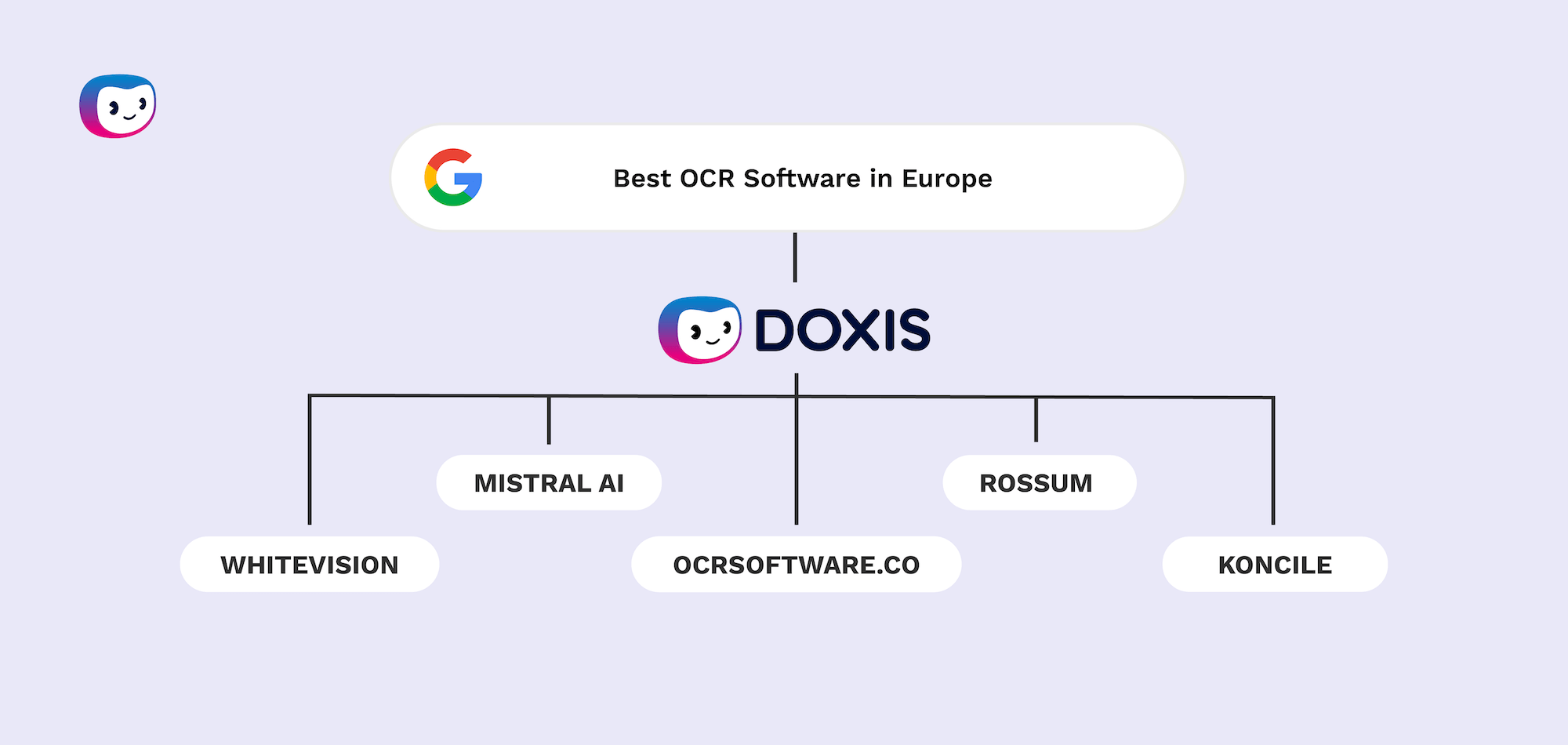
The 6 Best OCR Software Solutions in Europe are:
- Doxis AI.dp: Our top choice for 2026 🏆 Best for high-volume document processing across industries like finance, healthcare, and legal, offering AI-powered template-free extraction, fraud detection, and GDPR-compliant automation
- OCRSoftware.co: Best for dedicated, secure, and compliant OCR with up to 99% accuracy, advanced fraud detection, data validation, and seamless workflow integrations via API and SDK
- Mistral AI OCR: Best for enterprise-scale document processing with speed, multilingual accuracy, and cost-efficient API-based pricing
- Rossum: Best for enterprise accounts payable automation, offering AI-driven invoice processing with turnkey ERP integrations for SAP, NetSuite, Coupa, and Workday
- ChronoScan: Best for affordable, high-volume batch scanning and data capture with barcode recognition, line-item extraction, and one-time pricing starting at EUR 245
- Koncile: Best for French and European SMEs automating invoice and procurement processing with a hybrid OCR + LLM approach for context-aware data extraction
What Is OCR Software?
OCR (Optical Character Recognition) software converts printed, handwritten, or scanned text into machine-readable data. It analyzes the visual layout of documents, images, or PDF files and identifies characters, words, and structures. The extracted information is then exported as editable, searchable, and structured data that integrates directly into business systems like ERPs, CRMs, and accounting platforms.
What to Look for in OCR Software from Europe
Choosing OCR software involves more than comparing accuracy scores. Your regulatory environment, language diversity, and data sovereignty requirements all play a role. Here are the key factors to evaluate:
- GDPR compliance and data residency: Any OCR software you adopt will process sensitive business and personal data. For European organizations, GDPR compliance is non-negotiable. Look for providers that store and process data within the EU, hold certifications like ISO 27001 or SOC 2, and offer data anonymization features. A European-headquartered vendor simplifies this significantly.
- Multilingual and multi-script support: Europe spans dozens of official languages and alphabets. Your OCR software needs to handle German umlauts, French accents, Dutch diacritics, and Scandinavian characters without sacrificing accuracy. If your business operates in Central or Eastern Europe, Cyrillic support becomes relevant as well.
- Accuracy and AI capabilities: Modern OCR goes beyond simple character recognition. AI and machine learning improve accuracy on poor-quality scans, handwritten text, and complex document layouts. Look for providers that report accuracy rates of 95% or higher and offer features like intelligent pre-processing and contextual validation.
- Integration and deployment options: Your OCR software should connect to your existing infrastructure. API and SDK availability, ERP connectors (SAP, Oracle, Microsoft Dynamics), and export formats (JSON, XML, CSV, UBL) are all critical. Consider whether you need a cloud-based solution, on-premise deployment, or a hybrid approach.
- Document type coverage: Some OCR solutions specialize in invoices, while others support 100+ document types including passports, bank statements, contracts, and receipts. Evaluate whether the provider requires fixed templates or supports template-free extraction, which is more flexible for varying document layouts.
- Scalability and pricing: Whether you process 100 documents per month or 100,000, your OCR software should scale with you. Pricing models range from one-time licenses to pay-per-page and subscription plans. Enterprise buyers should look for volume-based pricing and dedicated support.
The 6 Best OCR Software Solutions in Europe
The following providers are all headquartered in Europe and serve businesses across the continent. Each brings a different strength to the table, from enterprise-grade automation to affordable desktop scanning.
1. Doxis AI.dp
Headquarters: Bonn, Germany
Best for: Enterprise and mid-market businesses needing end-to-end document automation
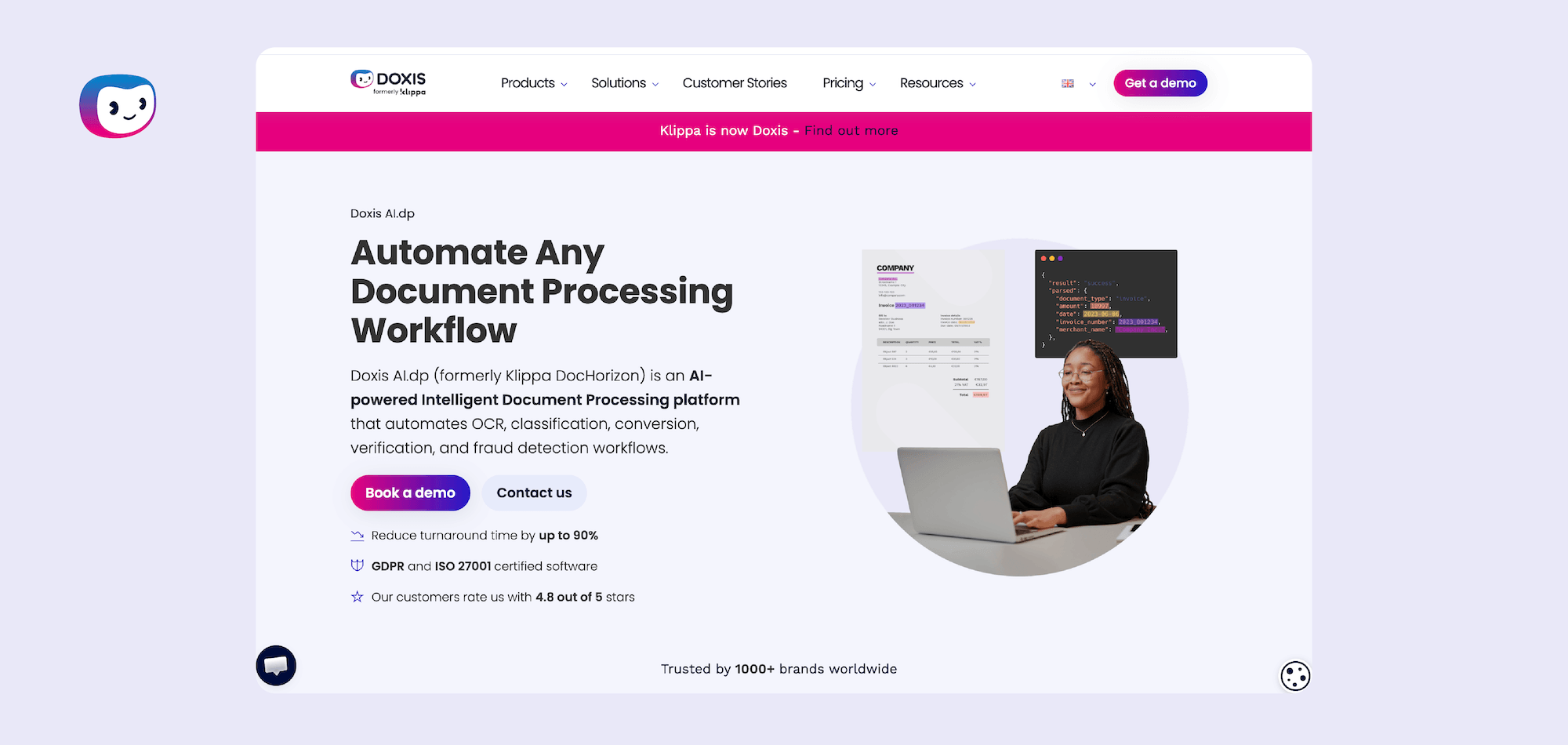
Doxis AI.dp is an AI-powered intelligent document processing platform that extracts, classifies, and verifies data from over 100 document types. Built in the Netherlands, it processes data within EU infrastructure and is GDPR compliant by design. Its template-free extraction uses machine learning to understand document structures, so it handles invoices, receipts, passports, and contracts regardless of layout variation.
The software includes built-in fraud detection through metadata and pixel-level analysis, plus data validation against third-party databases like European VAT registries. It integrates via API and SDK and exports to JSON, XML, CSV, XLS, and UBL formats.
Key strengths:
- Template-free AI extraction from 100+ document types
- Built-in document fraud detection and data validation
- GDPR compliant and ISO 27001 certified with EU-based data processing
- Integration via API and SDK, with connectors for ERP, CRM, and accounting systems
- Supports all Latin-script languages
Limitations:
- No support for non-Latin alphabets (e.g., Arabic, Chinese)
- Advanced integrations require some technical expertise
Pricing: EUR 25 free credit. License or usage-based pricing model. Contact Doxis for pricing details.
2. OCRSoftware.co
Headquarters: Europe
Best for: Large organizations in regulated industries needing high-accuracy extraction
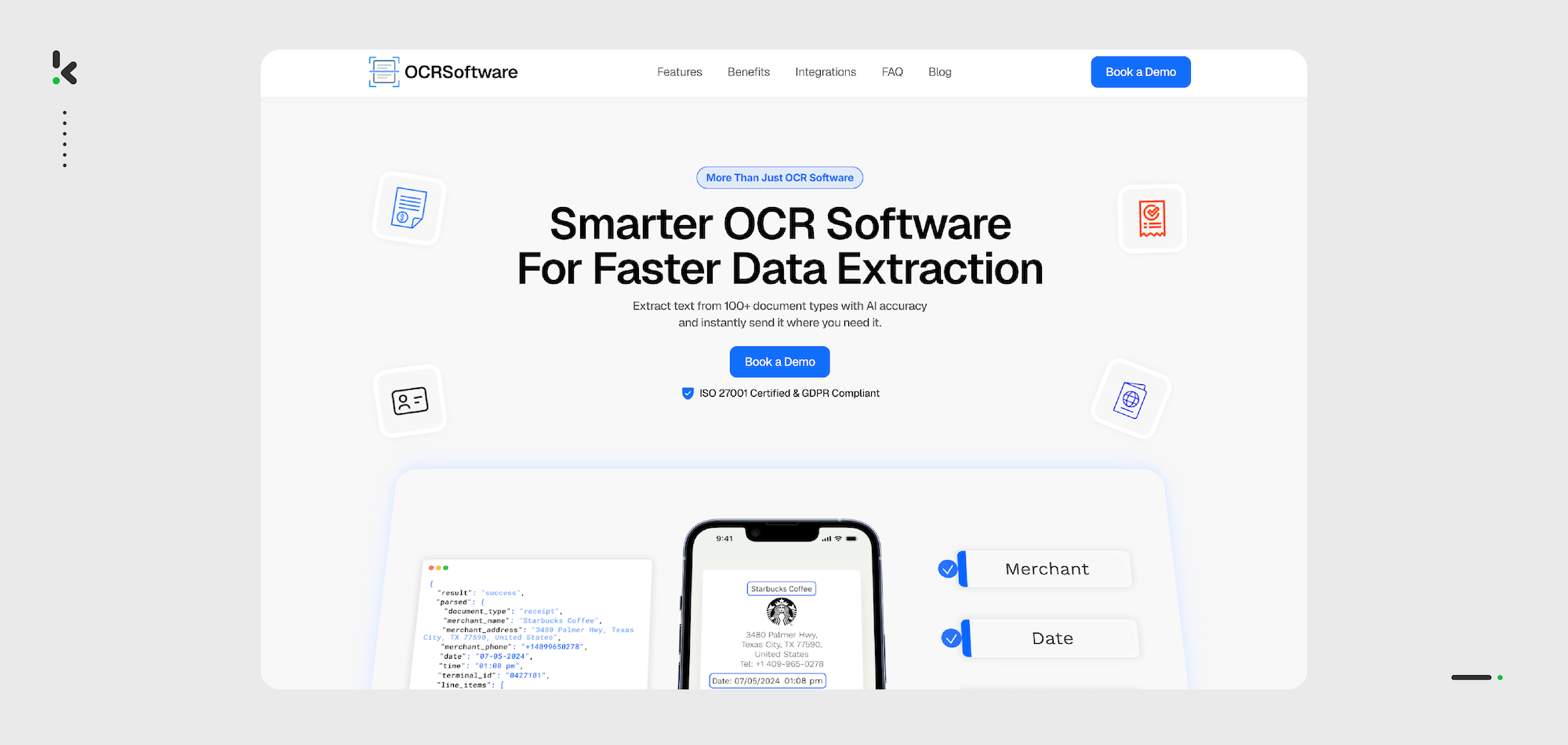
OCRSoftware.co is an AI-driven OCR platform that extracts data from invoices, receipts, ID cards, passports, and contracts with up to 99% reported accuracy. It supports multiple input channels (app, web, email, FTP) and uses advanced pre-processing to enhance scan quality before extraction. Template-free recognition adapts to varying document layouts without manual configuration.
The platform includes data validation and fraud detection, and integrates via API or SDK. Export formats include JSON, XLS, CSV, UBL, and XML. User testimonials highlight fast implementation and accurate identity document processing across multiple countries.
Key strengths:
- Up to 99% reported accuracy on supported document types
- Multi-channel input (app, web, email, FTP)
- Template-free extraction with built-in validation and fraud detection
- Export to JSON, XLS, CSV, UBL, and XML
Limitations:
- Limited recognition for non-Latin alphabets
- Onboarding support is required for non-technical users
Pricing: Custom licensing or usage-based model.
3. Mistral AI OCR
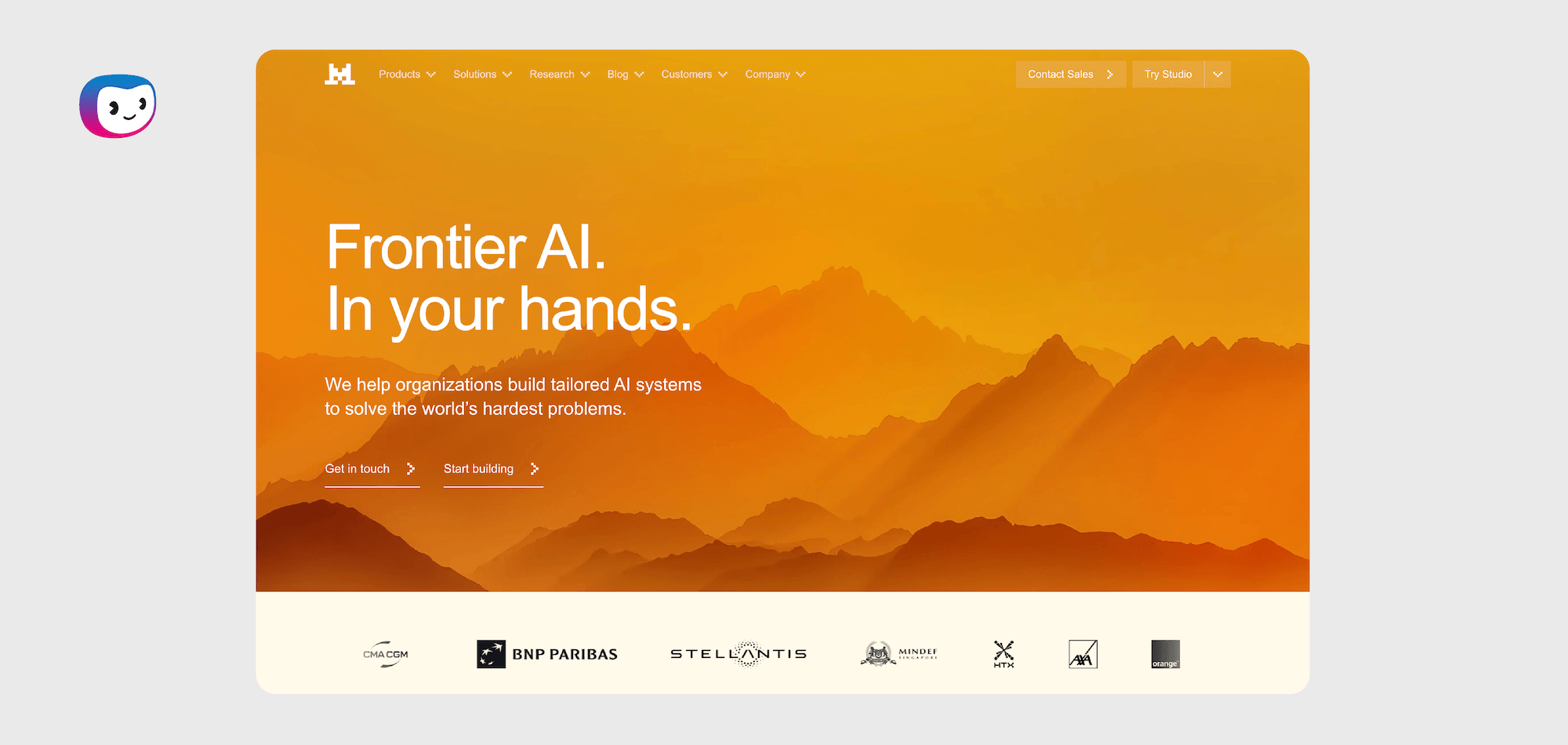
Headquarters: Paris, France
Best for: Enterprise-scale document processing requiring speed, multilingual accuracy, and API-first integration
Mistral AI is a French AI company that offers a dedicated OCR API as part of its Document AI stack. Mistral OCR processes up to 2,000 pages per minute on a single node and delivers 99%+ accuracy across 11+ languages, including handwritten text, complex tables, forms, and low-quality scans. The model outputs structured Markdown enriched with HTML table reconstruction, preserving both content and layout for downstream systems.
Mistral OCR is an API-first product, meaning it is designed for developers and technical teams building automated document pipelines. It supports self-hosting for organizations with strict data sovereignty requirements and integrates with cloud platforms like Microsoft Azure AI Foundry and Google Cloud Vertex AI.
Key strengths:
- Up to 2,000 pages per minute processing speed
- 99%+ accuracy across 11+ languages, including handwriting
- Structured output with HTML table reconstruction
- Self-hosting option for data sovereignty
- Cost-efficient pricing at $1-2 per 1,000 pages
Limitations:
- API-first product, not a no-code SaaS platform
- Requires developer resources for integration
- No built-in fraud detection or data validation
- Relatively new OCR product (launched 2025)
Pricing: $2 per 1,000 pages (Batch API: $1 per 1,000 pages).
4. Rossum
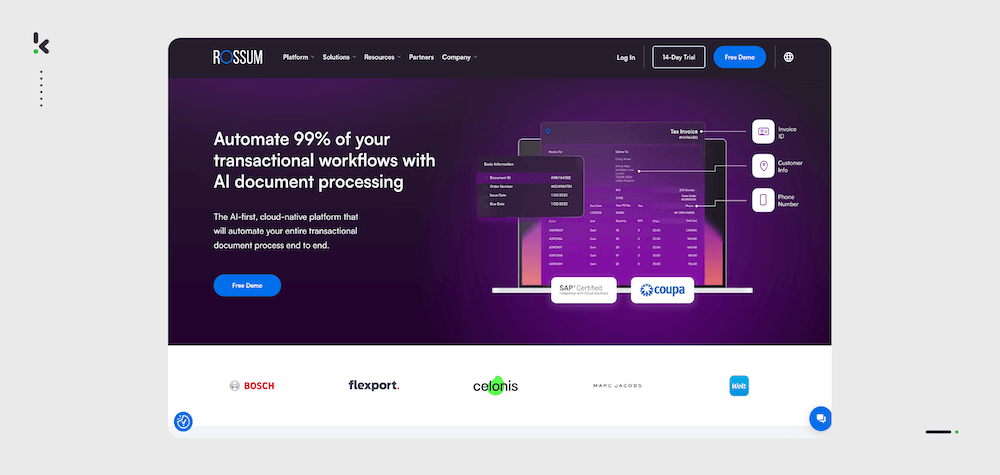
Headquarters: Prague, Czech Republic
Best for: Enterprise accounts payable teams automating invoice processing
Rossum is a cloud-native intelligent document processing platform founded in Prague in 2017, serving over 450 enterprise customers including Bosch, Siemens, and Panasonic. Its proprietary AI engine extracts data from invoices, purchase orders, and delivery notes without manual template setup, and includes a “Magic Grid” feature for line-item capture and editing.
Rossum offers turnkey connectors for SAP, NetSuite, Coupa, Workday, and Microsoft Dynamics and is ISO 27001 and SOC 2 Type II certified.
Key strengths:
- Purpose-built AI engine for transactional documents
- Turnkey ERP integrations (SAP, NetSuite, Coupa, Workday)
- ISO 27001 and SOC 2 Type II certified
- Supports 25+ languages
Limitations:
- Primarily focused on financial and procurement documents, not general-purpose OCR
- Pricing is prohibitive for smaller businesses
- Some users report a steep learning curve during initial setup (G2)
Pricing: Custom pricing, depending on the business’s requirements and needs.
5. ChronoScan
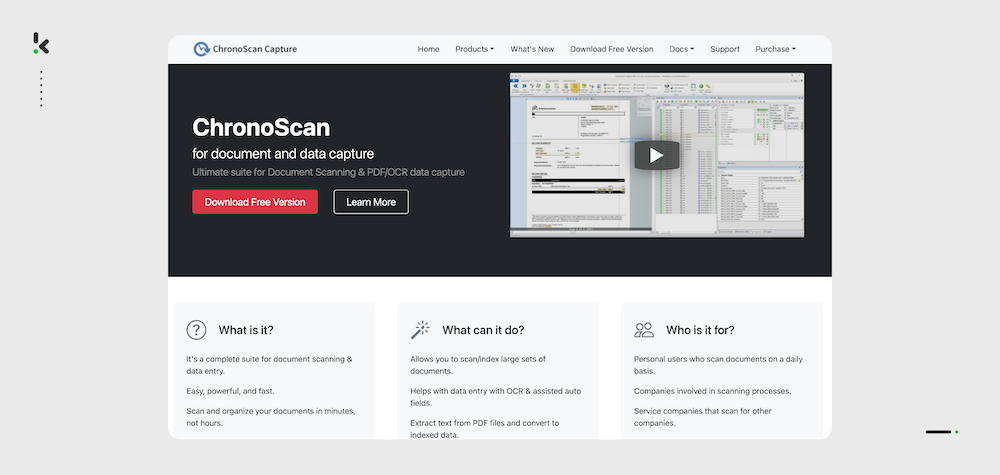
Headquarters: Madrid, Spain
Best for: Businesses needing affordable, high-volume batch scanning and data capture
ChronoScan is a document scanning and data capture suite developed by ChronoScan Capture S.L. in Madrid. It is built for batch processing and supports direct scanning, PDF text extraction, barcode reading, and line-item capture. The enterprise edition adds a web-based multi-user environment with ERP and CRM integration.
ChronoScan supports Google Cloud Vision as an optional OCR engine for poor-quality or handwritten documents.
Key strengths:
- Batch processing for high-volume document scanning
- Line-item, table, and barcode extraction
- Google Cloud Vision integration for AI-enhanced OCR
- Free for non-commercial use
Limitations:
- Primarily exports to XML and CSV formats
- No built-in fraud detection
- Advanced automation only available in the Enterprise edition
Pricing:
- Professional: EUR 245 (one-time, for small applications)
- Advanced: EUR 595 (one-time, for medium/big applications)
- Enterprise: custom pricing (for big/scalable applications)
6. Koncile
Headquarters: Nanterre (Paris), France
Best for: French and European SMEs automating invoice and procurement document processing
Koncile is a French AI-powered OCR startup founded in 2023 that combines OCR with large language models (LLMs) to extract structured data from invoices, contracts, bank statements, and identity documents. The hybrid approach means the software understands the meaning behind extracted text, distinguishing between a unit price and a reference code to deliver structured, validated output.
The platform processes documents in 1 to 2 seconds and includes automatic document classification, table extraction, and anomaly detection. Koncile also offers a procurement analytics module for spend management.
Key strengths:
- Hybrid OCR + LLM approach for context-aware extraction
- Custom extraction templates for targeted data capture
- Automatic document classification and page separation
- API and SDK integration
Limitations:
- Very early-stage company (founded 2023, small team)
- Language support limited to English and French
- No support for non-Latin scripts
Pricing:
- Starter (500 docs): EUR 129
- Advanced (up to 5,000 docs): EUR 799
- Enterprise: custom pricing
How Doxis Compares
With six strong European OCR providers on the table, the right choice depends on your specific needs. Here is how they stack up across the criteria that matter most:
Doxis AI.dp is the strongest all-around choice for European businesses that need scalable, AI-driven document automation with built-in compliance and fraud detection. If your primary use case is accounts payable in a large enterprise, Rossum is a strong alternative. For developer teams building high-throughput pipelines, Mistral AI OCR offers unmatched speed and cost efficiency. For budget-conscious businesses, ChronoScan offers an affordable entry point.
Automate Document Processing With Doxis
Processing documents manually is expensive, error-prone, and impossible to scale. Whether you handle invoices, identity documents, receipts, or contracts, Doxis software gives you a faster, more accurate, and fully compliant way to extract and validate data.
A recognized Leader in the Gartner® Magic Quadrant™ for Document Management, Doxis delivers advanced OCR and intelligent document processing capabilities to teams across industries, making AI.dp the top OCR platform choice for 2026.
Doxis AI.dp helps your business:
- Extract data from 100+ document types without templates
- Detect document fraud through metadata and pixel-level analysis
- Validate extracted data against third-party databases (VAT registries, chamber of commerce)
- Integrate seamlessly with your ERP, CRM, or accounting system via API or SDK
- Process documents in compliance with GDPR, with EU-based data storage
- Reduce manual data entry by up to 70%, freeing your team for higher-value work
Ready to see how Doxis fits your workflow? Request a free demo below or get in touch with our team to discuss your specific requirements.
FAQ
OCR (Optical Character Recognition) software converts images of text, whether from scanned documents, photos, or PDF files, into machine-readable and editable data. The software analyzes character shapes, applies pattern matching or AI-based recognition, and outputs structured text that your systems can process, search, and store.
Why should European businesses choose a European OCR provider?
European OCR providers process and store data within the EU, simplifying GDPR compliance. They also understand European document formats, multilingual requirements, and local regulations. Choosing a non-European vendor introduces additional complexity around data transfers, especially after rulings that restrict EU-to-US data flows.
What accuracy rate should I expect from OCR software?
Modern AI-powered OCR solutions achieve accuracy rates between 95% and 99% on standard printed documents. Accuracy depends on document quality, language complexity, and whether the software uses AI pre-processing. Handwritten text and degraded scans produce lower accuracy, but advanced providers like Doxis use machine learning to improve results on difficult inputs.
Is OCR software GDPR compliant?
OCR software itself is not automatically GDPR compliant. Compliance depends on how the provider stores, processes, and protects personal data. Look for providers with ISO 27001 certification, EU-based data centers, data anonymization features, and transparent data processing agreements. European-headquartered providers are subject to EU law by default, which adds an extra layer of assurance.
How much does OCR software cost in Europe?
Pricing varies widely. Desktop solutions like Readiris start at EUR 99 for a one-time license. ChronoScan offers professional licenses from EUR 245. Cloud-based platforms like Koncile start at EUR 129 for 500 documents. Enterprise solutions like Doxis AI.dp and Rossum use custom pricing based on document volume, features, and integration requirements.
Can OCR software handle multiple European languages?
Yes, but language support varies by provider. Readiris leads with 130+ languages including Cyrillic and Asian scripts. Doxis and OCRSoftware.co support all Latin-script languages, covering most of Western and Central Europe. Rossum supports 25+ languages, while Koncile currently supports English and French. Always verify that your required languages are included before committing.
What is the difference between OCR and intelligent document processing (IDP)?
OCR is the technology that reads and digitizes text from images. Intelligent document processing (IDP) is a broader category that combines OCR with AI, machine learning, and natural language processing to classify documents, extract specific data fields, validate information, and integrate with business systems. Providers like Doxis, Rossum, and Koncile offer IDP capabilities that go well beyond basic OCR.
How long does it take to integrate OCR software into my existing systems?
Integration timelines depend on the provider and your system architecture. API-based solutions like Doxis and OCRSoftware.co are designed for rapid integration, with some implementations completed within a single day. Enterprise platforms like Rossum, which include ERP connectors and approval workflows, require longer setup periods. Desktop solutions like Readiris and ChronoScan require no integration and work out of the box.