


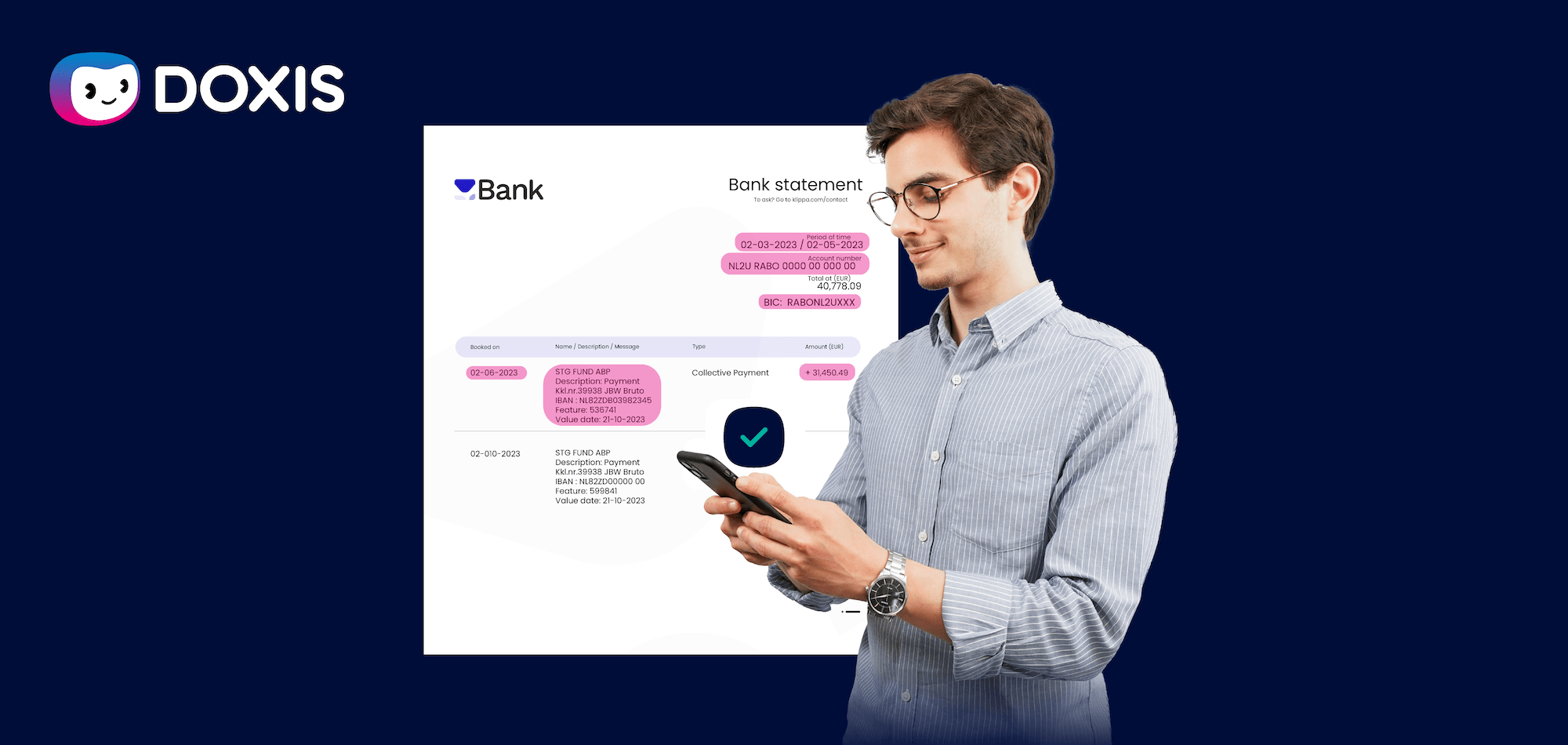
Bank statement verification is no longer a simple back office routine. It is now a vital safeguard against fraud, compliance failures, and costly mistakes. Automation is the fastest and most reliable way to protect your business and ensure accuracy.
Fraud is increasing, statement formats vary widely, and manual verification consumes valuable time while leaving room for human error. Sophisticated document manipulation can slip past visual checks, making falsification harder to detect. Regulations such as KYC and AML are becoming stricter, increasing the pressure to verify quickly and correctly.
Delays in verification affect loan approvals, hinder audits, and erode stakeholder trust. Even highly trained staff may miss subtle signs of tampering. Automated bank statement verification powered by OCR, AI, and Intelligent Document Processing delivers instant and accurate results, detects anomalies on the spot, integrates into your existing systems, and ensures compliance while allowing your team to focus on higher value tasks.
Key Takeaways
- Automated bank statement verification uses OCR, AI, Machine Learning, and digital forensics to process financial information quickly and accurately.
- AI-powered Intelligent Document Processing can handle diverse statement formats such as PDFs, Excel files, scanned images, and proprietary bank templates.
- Manual verification suffers from slow turnaround, high costs, human error, compliance risks, and difficulty detecting sophisticated fraud.
- Automation solves these issues by extracting, validating, and cross-referencing statement data with precision, integrating seamlessly into existing financial systems.
- Successful implementation involves assessing workflow needs, selecting the right verification software, integrating with internal platforms, training staff, and continuously monitoring performance.
- Doxis’ IDP platform offers end-to-end automation for bank statement verification, improving speed, accuracy, compliance, scalability, and fraud prevention.
Bank Statement Verification: Definition and Why It Matters
Bank statement verification is the process of confirming that a bank statement is genuine, accurate, and consistent with other financial records. It involves cross-checking the statement’s details such as account holder information, account number, balances, and transaction history against trusted sources. This might include comparing data against internal accounting records, other submitted financial documents, or directly contacting the issuing bank for confirmation.
The purpose is simple yet crucial: to ensure that the financial information provided is authentic and free from manipulation. Verification can be applied in many contexts including loan applications, audits, investment due diligence, and regulatory compliance. It is conducted by banks, lenders, auditors, insurers, accountants, and even private individuals who need to confirm the validity of their financial records.
Accurate bank statement verification matters because:
- It prevents fraud by catching forged or doctored statements before they cause damage
- It ensures regulatory compliance, helping meet KYC and AML obligations
- It validates income and creditworthiness for lending decisions and financial assessments
- It maintains transparency for stakeholders including investors, auditors, and regulators
- It protects financial integrity and reinforces trust in the institution handling the verification
In an era where financial crimes are rising and regulations are tightening, reliable bank statement verification is more than a procedural formality. It is a core risk management practice that shields businesses from operational disruptions, reputational harm, and costly errors.
How Manual Bank Statement Verification Works and Its Limitations
Manual bank statement verification involves checking each statement line-by-line, cross-referencing transactions against internal records, and confirming details with official sources when discrepancies arise. While this method can be sufficient for small volumes, it quickly becomes impractical in modern financial operations.
Manual bank statement verification is slow, labor-intensive, and prone to human error. Subtle signs of tampering often go undetected, especially with varied formats from multiple banks. As volumes grow, costs rise, compliance deadlines are missed, and operational bottlenecks become common.
Key pain points of manual verification:
- Time-consuming review that delays key workflows like loan approvals and audits
- High risk of human error during data comparison and reconciliation
- Difficulty detecting sophisticated fraud with altered formatting or metadata
- Complexity in processing diverse statement formats and layouts
- Limited scalability, requiring more staff as volumes increase
- Operational delays affecting customer experience and satisfaction
- Higher costs due to increased staffing and physical storage needs
- Compliance risks from slow or incomplete verification
Given these limitations, automation offers a faster, more reliable, and scalable way to ensure statements are accurate, secure, and compliant.
How to Verify Bank Statements Automatically
Automated bank statement verification transforms a slow, error-prone manual process into a fast, reliable, and scalable solution. By combining advanced technologies such as Optical Character Recognition (OCR), Artificial Intelligence (AI), Machine Learning (ML), and digital forensics, businesses can validate statements with a higher degree of accuracy while dramatically reducing verification times.
Step-by-step automated verification process:
1. OCR Data Extraction
OCR technology scans physical or digital bank statements and extracts relevant information including account holder details, account number, balances, transaction descriptions, dates, and amounts. It instantly converts this data into a standardized format for easier comparison across different documents and systems.
2. AI and ML Anomaly Detection
AI algorithms analyze the extracted data, detecting inconsistencies in transactions, formatting anomalies, or unusual account patterns. Machine learning enables these algorithms to improve over time, identifying increasingly subtle signs of forgery or tampering.
3. Digital Forensic Analysis
Advanced forensic tools examine hidden metadata and edit histories within digital statements, exposing alterations that may be invisible to the human eye. This method ensures even carefully manipulated PDFs or scanned documents are verified thoroughly.
4. Integration with Financial Systems
Automated verification software connects directly with accounting platforms, loan origination systems, or CRM databases. Statements are cross-referenced with internal records instantly, removing the need for manual checks and accelerating decision-making.
5. Real-time Verification
Automation enables 24/7 processing, meaning bank statements can be verified within seconds regardless of time zones or working hours. This feature is particularly valuable for lenders, auditors, or businesses that handle high volumes of transactions.
Why automation is superior:
- It processes statements far quicker than manual checks
- Data accuracy improves through standardized extraction and comparison
- Fraud detection is enhanced using AI, ML, and forensic validation
- Compliance requirements are met more easily thanks to automated audit trails
- Verification scales effortlessly, handling thousands of statements without increasing headcount
Automated bank statement verification does not just replicate manual methods. It strengthens them with intelligent analysis, integration capabilities, and rapid turnaround, making it an essential upgrade for any organization that values speed, accuracy, and security.
Why Automation Matters and How to Pick the Right Tool
Automated bank statement verification replaces slow, error-prone manual checks with fast, accurate validation powered by OCR, AI, Machine Learning, and digital forensics. It processes statements instantly, reduces human error, detects fraud, ensures compliance, and scales effortlessly. Integrated into your existing systems, it speeds decisions, cuts costs, and enhances customer satisfaction.
To gain these benefits, choose software that meets your operational and compliance needs. The best solutions pair advanced technology with features that make workflows efficient and seamless.
Key Features to Look For:
- Accuracy and Speed
The foundation of effective verification is precise data extraction. The software should capture every figure and detail without errors, even from low-quality scans or complex layouts, and process large volumes in seconds to avoid delays. - Format Compatibility
Support for multiple file types including PDFs, Excel, scanned images, and proprietary bank formats ensures consistent accuracy without manual file conversion. - Fraud Detection Capability
AI-driven anomaly detection and forensic tools should flag unusual patterns, altered metadata, and suspicious formatting that may indicate tampering. - Compliance Tools
Built-in features for KYC, AML, GDPR, and SOC standards, including secure audit trails and consistent workflows, help meet regulatory demands and ensure smooth audits. - Security Measures
Strong encryption, role-based access controls, and certified hosting protect sensitive financial data from breaches or unauthorized access. - Integration Options
Direct connections to accounting platforms, CRM systems, and loan origination tools streamline reconciliation and keep data aligned across departments.
Selecting a solution with these capabilities will allow your business to verify bank statements quickly, accurately, and securely while unlocking the operational benefits of automation.
How Doxis AI.dp Can Help With Bank Statement Verification
Doxis AI.dp offers an Intelligent Document Processing API designed to remove the inefficiencies and risks of manual bank statement verification. With Doxis, you can process statements in any format, detect anomalies instantly, and achieve full compliance with financial regulations, all without disrupting your existing workflows.
How bank statement verification with Doxis works:
- Seamless system integration: Connect directly to accounting platforms, CRM systems, and loan origination tools without redesigning your core processes.
- Real-time statement processing: Instantly extract and validate account details, balances, and transactions from PDFs, images, Excel files, and proprietary bank templates.
- Fraud detection built-in: AI and digital forensics identify unusual patterns, altered metadata, and formatting inconsistencies that indicate potential manipulation.
- Compliance-ready: Fully aligned with KYC and AML standards, generating secure audit trails for every verification.
- Secure and certified: Hosted on GDPR-compliant infrastructure with encryption, access controls, and ISO 27001, SOC 2 certification to protect sensitive financial data.
- Scalable automation: Handles thousands of statements with the same precision and speed as a single file, reducing workload and operational costs.
Whether you are processing statements for loan approvals, audits, onboarding, or fraud prevention, Doxis acts as the high-speed accuracy layer your verification process is missing. It makes your operations scalable, compliant, and secure while keeping your current systems intact.
To see how Doxis can help transform your bank statement verification workflows, contact our experts or book a free demo and explore the impact of automation on your business.
FAQ
Bank statement verification is the process of confirming that a bank statement is genuine, accurate, and consistent with other financial records. It involves checking the account holder’s details, balances, transactions, and document integrity against trusted sources or through automated tools.
2. Why is bank statement verification important for my business?
Verification protects your business from fraud, ensures compliance with regulations like KYC and AML, validates income and creditworthiness, and maintains trust with auditors, investors, and customers.
3. What are the risks of manual bank statement verification?
Manual verification is time-consuming, prone to errors, and difficult to scale. It can miss subtle signs of fraud, cause delays in approvals or audits, and lead to compliance risks when deadlines are missed.
4. How to verify bank statements automatically?
Automated verification uses OCR to extract data, AI and Machine Learning to detect anomalies, and digital forensics to uncover hidden alterations. It integrates with financial systems for real-time cross-referencing, processes documents in seconds, and generates secure audit trails for compliance.
5. How does automated bank statement verification work?
Automated verification involves scanning statements with OCR, analyzing them using AI and ML, detecting suspicious patterns or alterations, and comparing extracted data to internal records for instant validation.
6. What are the benefits of automating bank statement verification?
Automation delivers faster processing times, reduced human error, stronger fraud detection, scalable operations, lower costs, and improved customer experience, while ensuring compliance and security.
7. How do I choose the right bank statement verification software?
Look for accuracy, speed, compatibility with multiple formats, compliance features, robust security, integration capabilities, and cost-effectiveness.
8. How can Doxis AI.dp help my business?
Doxis AI.dp provides Intelligent Document Processing with advanced OCR, AI, and secure infrastructure. It processes bank statements in any format, integrates with your systems, detects fraud instantly, and ensures full compliance with financial regulations.