


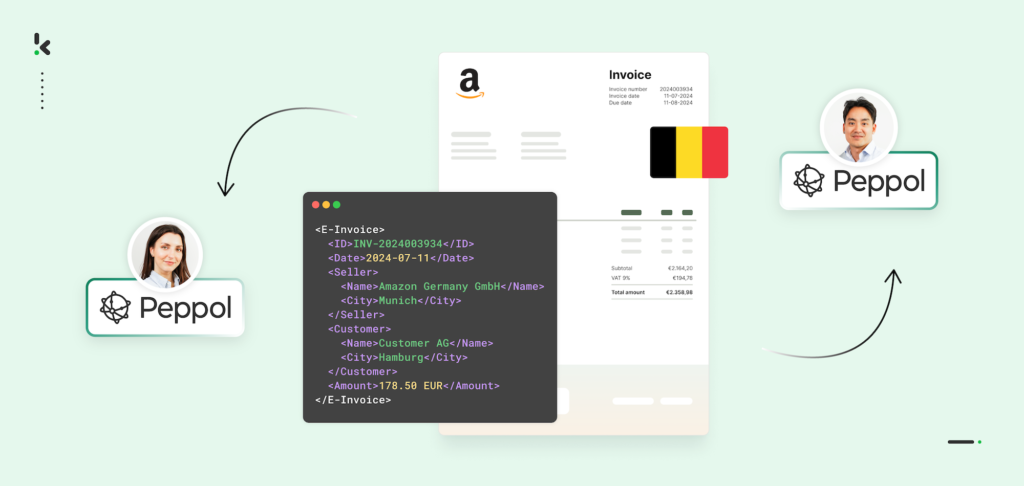
The Belgian B2B e-invoicing mandate is now a legal reality for all VAT-registered businesses. The days of sending paper invoices or PDFs via email are over for domestic transactions.
If your business is still relying on these manual methods, you are operating outside the current legal framework.
If you have not yet implemented e-invoicing, the consequences for non-compliance become severe. Your business could face administrative fines ranging from €1,500 to €5,000 per violation.
Furthermore, many companies now automatically reject any invoice that is not a valid Peppol BIS 3.0 file, leading to immediate payment delays and disrupted cash flow.
Whether you are still working on your initial implementation or have realized that your current solution is too manual, there is a clear path forward. By focusing on a high automation Peppol setup, your business can turn this mandate into a competitive advantage.
This guide provides a direct look at the state of e-invoicing in Belgium today and shows you exactly how to optimize your setup or switch to a better provider before it is too late.
Key Takeaways
- B2B mandate is active: Structured electronic invoicing is now the legal requirement for domestic transactions between all VAT-registered businesses in Belgium.
- PDFs are legacy: Sending a PDF via email is no longer legally compliant for B2B sales; your invoices must now be machine-readable XML files (UBL 2.1) following the Peppol BIS 3.0 standard.
- E-reporting starts in 2028: The e-invoicing setup you implement now is the necessary foundation for the mandatory real-time tax reporting requirements arriving in January 2028.
- Performance drives the switch: Many businesses are moving away from basic portals toward automated providers to reduce manual data entry, high per-invoice costs, and frequent rejections.
- Switching is simple: You are not locked into one provider; you can migrate your Peppol ID (KBO number) to a more efficient Access Point without changing your digital address or disrupting your business.
E-Invoicing in Belgium: The State of Play
The transition to digital invoicing is no longer a future project. It is the current standard for business in Belgium. The government moved away from paper and PDFs to close the VAT gap and make business operations more efficient through automation.
Who needs to comply?
The rules apply to almost every VAT registered business established in Belgium. If your company sells goods or services to another Belgian business, you are required to use structured e-invoicing.
While there are a few exceptions for specific exempt sectors or small businesses with specific regimes, the vast majority of B2B transactions now fall under these requirements.
The official standard: Peppol BIS 3.0
Belgium chose Peppol BIS 3.0 as the mandatory format. This is a structured XML file that follows the European EN 16931 standard. It is a machine-readable format that allows different accounting systems to talk to each other without any manual data entry.
- Universal Language: It uses a structured XML format (UBL 2.1) that all compliant accounting systems can read without manual entry.
- Simplified Compliance: Belgium has chosen to use the standard Peppol specifications without adding complex national extensions.
- New VAT Rules: Starting with the mandate, VAT rounding is only allowed at the total level per VAT rate. Rounding per individual line item is no longer permitted.
Compliance and enforcement
The law requires all domestic B2B invoices to be sent via the secure Peppol network. Technical non-compliance can lead to administrative fines. These start at 1,500 Euro for a first offense and can go up to 5,000 Euro for repeated issues.
Beyond the fines, many companies now automatically reject invoices that are not in the correct format, which can lead to significant payment delays for your business.
E-Reporting in 2028: The Next Big Step
While structured e-invoicing is the hurdle you need to clear today, it is actually part of a much bigger plan to modernize the Belgian tax system. The next major milestone is set for January 1, 2028, when mandatory e-reporting kicks in.
This move shifts the country from traditional periodic tax reporting to a system of continuous transaction controls.
What does e-reporting actually mean?
Currently, the Peppol network works on what we call a four-corner model. Your invoice moves from you to your customer via your respective access points.
In 2028, Belgium is moving toward a five-corner model. This means that every time you send or receive a Peppol invoice, the data is automatically shared with the Belgian tax authorities in near real-time.
Instead of waiting for you to file a tax return at the end of the quarter, the government receives the transactional data almost as soon as the invoice is sent.
This allows the tax office to cross-reference data instantly, making it much easier for them to spot errors and reduce the VAT gap.
The end of the annual client listing
There is a big plus for your business here. Because the government will already have all your transaction data, the need for some of those manual, time-consuming reports will disappear.
Most importantly, the e-reporting system is expected to replace the mandatory annual customer listing.
This removes a tedious administrative task from your yearly calendar and frees up your finance team for more important work.
Why it pays to prepare now
Even though 2028 feels like it is a long way off, the foundation for e-reporting is the structured e-invoicing system you are setting up right now.
You cannot have real-time reporting without a high-quality, automated flow of Peppol invoices.
By choosing a provider that is already built with these future requirements in mind, you can rest easy knowing you won’t have to overhaul your entire IT setup all over again in a few years.
Why Your Business Might Need to Switch Peppol Providers
Many businesses in Belgium rushed to find an e-invoicing solution to meet the initial deadline. While most found a way to connect to the Peppol network, not all solutions are created equal. You might find that your current setup is causing more work than it saves.
There are several reasons why you might consider moving to a different provider:
Hidden costs and scaling issues
Some providers offer low entry prices but charge high fees for every single invoice sent or received. As your business grows and the number of transactions increases, these costs can quickly spiral out of control.
If your provider does not offer a transparent or scalable pricing model, it could be costing you much more than necessary.
Lack of true automation
A common frustration is having a Peppol connection that still requires manual work. If you have to export data from your ERP, manually upload a file to a portal, and fix formatting errors yourself, you aren’t really benefiting from automation.
A good provider should act as a bridge that handles all the technical heavy lifting in the background without your team needing to intervene.
Frequent invoice rejections
Peppol BIS 3.0 has strict validation rules. If your provider has a weak validation engine, your invoices might be sent with small errors that cause them to be rejected by your customers.
This leads to payment delays and extra administrative work to correct and resend documents. You need a partner that catches these errors before they ever leave your system.
Poor integration with your current software
If your Peppol access point doesn’t talk to your existing accounting or ERP software, you end up with fragmented data. This makes bank reconciliation and financial reporting much harder.
Many businesses switch because they need a provider that offers a reliable API or direct plug-ins for the tools they already use.
How to Switch Peppol Providers: A Step-by-Step Guide
Moving to a new provider is a standard procedure because the Peppol network is designed to be open. Your Peppol ID, which is usually your KBO number, stays with you, much like a phone number when you switch mobile carriers.
If your current service is too slow, too expensive, or just doesn’t integrate well with your software, here is how you can move to a better setup.
Step 1: Set up your new account
Before you disconnect from your old service, make sure your new provider is ready. You should verify that they can handle the specific Belgian requirements for Peppol BIS 3.0 and that they offer the right integration for your accounting system.
Having this ready ensures you won’t have any downtime where you can’t receive invoices.
Step 2: Finalize pending invoices
Check your current dashboard to make sure all your outgoing invoices have been successfully delivered. If there are any rejections or errors, fix them before you start the move.
It is also a good idea to let your main suppliers know you are switching, even though the network technically updates your address automatically.
Step 3: Archive your invoice history
This is a critical legal step. You are required to keep your e-invoices for seven to ten years in Belgium. When you leave a provider, you might lose access to their portal.
Before you close your account, download all your original XML files and the processing logs. You need these for future audits, so do not rely on your provider to keep them for you after you leave.
Step 4: Deregister from the old Access Point
In the Peppol network, your business can only be linked to one “post office” at a time for receiving invoices. You need to ask your current provider to unpublish your KBO number from the network registry.
Some providers have a button for this in their settings, while others require you to send a formal request to their support team.
Step 5: Activate the new connection
Once the old link is removed, your new provider can register your KBO number on the network. This update usually takes anywhere from a few minutes to a couple of hours to spread across the global directory.
From that moment on, all incoming invoices will flow directly into your new, more efficient system.
Why Choose Klippa DocHorizon for Your Belgian E-Invoicing?
Choosing an e-invoicing partner is about more than just getting a connection to the network. It is about making sure the transition actually makes your life easier.
At Klippa, we specialize in taking the manual work out of document processing, ensuring your business stays compliant without adding to your workload.
Your e-invoicing solution should not be a silo. Klippa DocHorizon acts as a bridge between your existing ERP or accounting software and the Peppol network.
By using our Intelligent Document Processing technology, we can automatically convert your data into 100% compliant Peppol BIS 3.0 files. This allows you to keep your current workflows while we handle the technical heavy lifting and validation in the background.
- Certified Peppol Access Point: Direct and secure connection to the global Peppol network for reliable invoice delivery.
- AI-Powered Data Extraction: Automatically turn PDFs or even scans into structured XML files with high accuracy.
- Seamless ERP Integrations: Connect directly with systems like SAP, Microsoft Dynamics, Odoo, and more via our robust API.
- 100% Belgian Compliance: Automated validation against BIS 3.0 rules, including correct VAT rounding and KBO identification.
- Scalable Pricing: Transparent costs that grow with your business, whether you process ten invoices or ten thousand.
- Future-Proof Technology: Ready for the 2028 e-reporting mandate, so you only have to implement a solution once.
If you want to see how this works for your specific setup, feel free to get in touch with our experts or book a free demo below!
FAQ
Peppol BIS 3.0 is a set of specifications that ensures electronic invoices are structured in a way that any accounting system can understand. It is based on the European standard EN 16931. The Belgian government has made it mandatory because it allows for automated processing and real time validation of tax data. This reduces errors and helps the tax authorities close the VAT gap.
2. Can I still send PDF invoices to other Belgian businesses?
For domestic B2B transactions, a PDF sent via email is no longer considered a valid invoice under the new mandate. While you might still use PDFs for B2C transactions or international clients, Belgian B2B sales must be handled via structured XML files sent through the Peppol network. If you continue to use PDFs for these transactions, you risk fines and your customers might not be able to deduct the VAT.
3. How do I register for a Peppol ID in Belgium?
Your Peppol ID is your unique address on the network. In Belgium, this is almost always your KBO or CBE number. To register, you need to sign up with a certified Access Point provider like Klippa. They will verify your business details and publish your ID to the global Peppol directory. This allows other businesses on the network to find you and send you invoices automatically.
4. What happens if an invoice is rejected by the Peppol network?
If an invoice is rejected, it usually means it failed a validation check. This could be due to a missing VAT number, an incorrect tax calculation, or a formatting error in the XML file. Unlike a lost email, the Peppol network will provide you with a specific error message. You will need to correct the data in your system and resend the invoice. A high quality Access Point will help you catch these errors before they are even sent.
5. How does the 2028 e-reporting mandate affect my current setup?
The 2028 mandate will introduce a five corner model where invoice data is shared with the tax authorities in real time. If you have already implemented a structured e-invoicing workflow using Peppol BIS 3.0, you are already ahead. The main change will be the automatic transmission of your invoice data to the government portal. This will eventually replace the need for the annual client listing.
6. Is it difficult to switch my Peppol Access Point provider?
Switching providers is a straightforward process. Because your Peppol ID is tied to your business and not the provider, you can migrate to a new service without changing your digital address. You simply need to deregister from your old provider and activate your account with the new one. Most of the work involves ensuring your historical data is archived and your API integrations are updated to point to the new provider.
7. Do I need to change my ERP system to use Peppol?
Not necessarily. Many older ERP systems do not support Peppol BIS 3.0 natively, but you can bridge this gap using an external Access Point or an Intelligent Document Processing solution. A provider like Klippa can take the output from your current system and automatically transform it into the required XML format, allowing you to stay compliant without a full software overhaul.